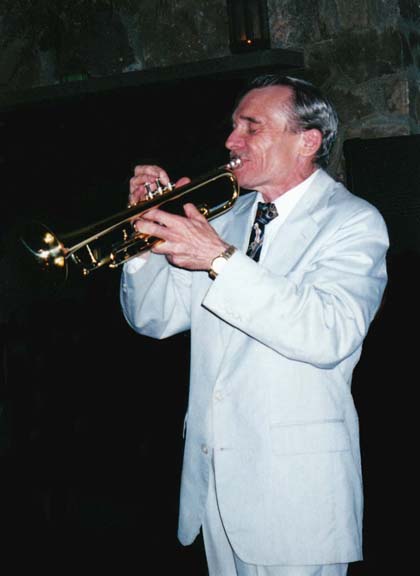
This was another early lp purchase by a young trumpet student and jazz fan.
It introduced me to New Orleans style Dixieland and the talents of Al Hirt,Pete Fountain and Bob Havens.
Al, I had seen on TV a few times.I was impressed by his awesome technique and showmanship,although I could see that taste wasn't one of his talents.
Pete,who I'd seen on the Lawrence Welk show , was always a natural,swinging player with shades of the great Irving Fazola. We also get the bonus of his booting tenor sax with shades of hometown boys Eddie Miller and Lester Bouchon.
Another future Welk member was Bob Havens who was playing with Al in New Orleans when these
sides were made (1956).He had as much technique as Al,but knew how to ration it and there touches of the great Jack Teagarden.He became one of my favorite trombonists.
The Rhythm section is made up of three New Orleans pros-Roy Zimmerman,piano-Bob Coquille,
bass and Paul Edwards,drums. Along with Al and Pete,they put in time with such New Orleans
bands as the Dukes of Dixieland,Sharkey Bonano,Tony Almerico and George Girard.
Roy gets in a few short solos and sounds great.Coquille and Edwards give solid support with Edwards getting in some nice tags.
Despite the Bombastic tendencies of Al,the Band does use some nice dynamics and uses a cute trick
of jumping up a step on the A strain to Panama.
As mentioned Pete gets in some rollicking Tenor choruses on Washington and Lee. He also plays
some Tenor on Wolverine Blues,a nice cut that is ruined by Al' pyro techniques on the out chorus. At
least they come down in Volume on the reprieve.
Other highlights include a mellow tune,I'm Goin' Home,written by two New Orleans boys Paul Mares, Pinky Vidacovitch and ex-N.O. Rhythm King,Mel Stitzel.
Pete gets to stretch out on Tin Roof Blues,always a great showcase for his Low Register improvisations.(he recorded a similar version with the Dukes of Dixieland,the previous year.)
He definetly listened to fellow homeboy,Irving Fazola.
Bob gets the feature on Blue and Broken Hearted with some of his Teagarden-ish licks on display.
At age 26,he was a mature soloist and in 1960 would join the Lawrence Welk show for a 12 year run.
Al's feature is Night and Day,where he goes into a Double-Timed exhibition of his great technique.
Not much jazz here,but some amazing Trumpet work!
Many years later,I can still enjoy this session that features three giants of their instruments playing
some great Traditional favorites along with the aforementioned features.
It's currently available on the CD, The Best of Dixieland-Al Hirt on Verve records.
Also heard is Jazz Me Blues, South Rampart St. Parade,Sugar,Dixieland One Step and Royal Garden Blues.
Saturday, October 20, 2018

Saturday, October 14, 2017
Waxing Nostalgic: Red Nichols-Meet the 5 Pennies
The wonderful cornetist and bandleader Red Nichols had many highlights in his 4 decade career.
Starting with his great 1920s sides with Miff Mole,his later 5 Pennies sessions with future jazz
greats Benny Goodman,Jack Teagarden,Glenn Miller and Gene Krupa,his underated big band of the late 30s
and finally his return to the 5 pennies in the late 40s until his untimely death in 1965.
The 1959 film The Five Pennies starring Danny Kaye and Louis Armstrong , despite it's lack of factual bio and Hollywood-ized treatment of
Red's life did a lot to bolster his career in the late 50s.
This album,one of Red's many fine Capitol lps features songs from the film,old and original
played by Red and his augmented Pennies. This was one of my favorites of Red's Capitol lps as a young jazz fan.
First a look at the players surrounding Red and his still potent cornet.
First his regular 5 Pennies-clarinetist Bill Wood,a tasty Goodman type player who stayed with Red
over 10 years,Pete Beilman,trombone,a veteran of the Ted Weems band and many west coast studio groups. Bobby Hammack,a very talented pianist and arranger who worked with Red most of the 50s.
Drummer Rollie Culver,a tasty player with Red since the mid 40s and the Bass Sax of Joe Rushton who kept the tradition of Adrian Rollini-(on many of Red's 1920s sides.)
Now the talented ringers: Clarinetist/arranger Heinie Beau goes back to Red's 1939 big band and
did the arrangements and transcriptions of the originals. He was a fine clarinetist(starred with Tommy Dorsey 1941-3) and consumate arranger,adept at dixieland but also wrote charts for Movies and TV and Frank Sinatra. He did most of the arranging for the Five Pennies movie.
On Alto and Baritone is Wayne Songer,a top studio man who subbed with the Pennies on occasion
and has that singing Jimmy Dorsey sound,found on many of Red's 20s sides. Trombonist Moe Schneider,another top studio hand, member of the Pete Kelly's Big 7 and sub with the Pennies.
Red used the tympani of Vic Berton and mellophone of Dudley Fosdick a lot on his 20s sides.
Here Ralph Hansell handles all Percussion and Jackie Coon, an excellent West Coast trumpeter
chips in many tasty solos on the unusual mellophone (a bit like a valve trombone or alto horn).
Several of Red's original solos are scored here for 3 trumpets with Bob Goodrich (ex Bob Crosby) and the great studio man Mannie Klein added-Manny was on several of Red's original 20s sides.
Rounding out the rhythm are studio pros Allen Reuss,guitar and Morty Corb,bass.
And now-on to the Program.
Eccentric-The old New Orleans Rhythm Kings favorite borrows from Red's original 1927 version arranged by Fud Livingston..
Heinie Beau scores Red's original solo for the 3 trumpets and we also hear tasty solos from Wood
and Coon on mellophone.Red's longtime trombonist Pete Beilman also gets in a nice solo.
Allah's Holiday- Another early Nichols recording (1929)-sort of a Japanese Sandman sound-alike.
Joe Rushton leads the opening theme (a regular Nichols device going back to Rollini).
Red gets in a mellow spot with more from Joe and Wood's clean swinging clarinet. Red leads the outchorus and the coda has a neat Japanese touch.
Indiana-Another classic chart from the Goodman-Teagarden period(1929-30). Beau's chart pretty much follows the original by Glenn Miller.. Once again,Red's original solo is scored for the 3 trumpets.
We also hear Songer's clean,swinging alto along with Wood and Coon.
When the Saints go Marching In. In the film,this was a delightful vocal duet with Kaye and Louis.(with special material by Kaye's wife Sylvia Fine). The arrangement is by Red and Beau.
This version follows Red's 2 part Pennies arrangement( a la Battle Hymn). After an intro by Red
over sustained chords Bobby Hammack takes us into the bluesy slow section led by Red.
Rollie's drum rolls takes us to the uptempo section. The entire ensemble swing out followed by neat
trade offs between Moe and Pete on trombone,Songer and Coon,the clarinets of Wood and Beau,baritone of Songer and Rushton's bass sax. After a spot by Rolie's drums,Red leads the entire
group home with a neat walkoff coda.
Shim Me Sha Wabble -The Spencer Williams favorite was originally recorded in 1930 with
Teagarden,Goodman and Krupa. Beau uses some of the original Glenn Miller chart.
We get some of the Berton tympani touch up front. Red leads the ensemble and we get nice
solos from Songer and Coon ( a fine trumpeter who worked with Teagarden , Pete Fountain and recorded with
Matty Matlock-he got a lot out of the quirky mellophone). Red leads the ensemble over the Miller
riffs with some more tympani on the coda.
The Five Pennies-This is the movie's title tune written by Sylvia Fine.(Red had a 1926 original of the same title) We get a pretty Beau chart with Rushton on lead with nice spots by vibes(Hansell).
Red takes over on the second chorus with a pretty statement of the lead ending in a lovely cadenza
over the band chords. Very pretty record.
Bill Bailey-The old favorite was sung by Louis in a nightclub scene. Beau gives us a loose swinging
version. Highlights are Red's solid lead,solos by Wood and Songer and more tympani spots.
Lullaby in Ragtime- Another Fine original. In the film,Kaye,Louis and young Susan Gordon (as Red's daughter Dorothy) sing a round of Lullaby,Five Pennies and another Fine comp. Goodnight-SleepTight. This has nothing to do with Red but makes for nice listening.
Beau gives us a nice chart with some Bob Crosby style reed voicings, a nice chorus by Red over a
shuffle rhythm and spots for Songer,Coon,Hammack's celesta and the tympani.
Battle Hymn of the Republic. A fixture in Red's book since the mid 40s. Like Saints, this Red-Beau
chart has the two part tempo routine with Red leading off unaccompanied into the slow drag tempo
and Wood's clarinet. A drum roll brings us into the swinging passages.
Bobby Hammack has two swinging choruses. He was a great pianist and like Beau,a talented arranger. Old Time Radio has several of his own radio shows on CD-it's very tasty.
Red gets dirty for one chorus,then proud and strutting. We also get Pete and Moe alternating,
Wood's clarinet,Joe's bass sax and stops for Rollie. After a modulation Red leads two swinging
choruses with his last chorus scored for 3 trumpets including his patented chromatic run on the coda.
In the movie, Red and Louis performed an exciting version in the nightclub scene and the song was
reprised during Red's climatic comeback scene.
Margie. Red's original was from 1928 and the original Fud Livingston chart is transcribed by Beau.
We start right off with Red's original solo played for 3 trumpets.Mannie Klein was on the 1928 record
and gets a tasty solo before Red takes over. Bill and Heinie split clarinet and there's a great guitar spot by Allan Reuss before Red leads the band home.
Red's Capitol albums all contain great music and that great Capitol sound..He started recording for them in 1944(78 sessions)
and also recorded in '45 and '50.
The LPs are the following:
In Love with Red (1955/6)-An augmented Pennies plus strings playing a more concertized program.
Hot Pennies (1956). The augmented Pennies playing many standard Nichols favorites.
Parade of the Pennies (1958). A similar setup and program.
At Marineland (1958)-Red's working six piece band in a collection of his regular program.
Meet the Five Pennies (1959).
Dixieland Dinner Dance (1959). The regular band plays a danceable program.
Dixieland Supper Club (1961). More danceable sounds.
Blues and Old Time Rags (1963). Ragtime favorites featuring Bill Campbell,piano and traditional
favorites.
It's a shame that Mosaic records(now defunct) never got to these albums-it would have made a great collection.
There is a nice Retrospective 2 CD set from the UK titled Both Sides of the Five Pennies.
Disc One has the clasic early Nichols from 1926-31 and disc Two highlights the Capitol years with
selections from Hot Pennies, Parade of the Pennies,Meet the Pennies and Dixieland Supper Club.
If you still have the original LPs,hang on to them.
Till our next Waxing Nostalgic.....
Starting with his great 1920s sides with Miff Mole,his later 5 Pennies sessions with future jazz
greats Benny Goodman,Jack Teagarden,Glenn Miller and Gene Krupa,his underated big band of the late 30s
and finally his return to the 5 pennies in the late 40s until his untimely death in 1965.
The 1959 film The Five Pennies starring Danny Kaye and Louis Armstrong , despite it's lack of factual bio and Hollywood-ized treatment of
Red's life did a lot to bolster his career in the late 50s.
This album,one of Red's many fine Capitol lps features songs from the film,old and original
played by Red and his augmented Pennies. This was one of my favorites of Red's Capitol lps as a young jazz fan.
First a look at the players surrounding Red and his still potent cornet.
First his regular 5 Pennies-clarinetist Bill Wood,a tasty Goodman type player who stayed with Red
over 10 years,Pete Beilman,trombone,a veteran of the Ted Weems band and many west coast studio groups. Bobby Hammack,a very talented pianist and arranger who worked with Red most of the 50s.
Drummer Rollie Culver,a tasty player with Red since the mid 40s and the Bass Sax of Joe Rushton who kept the tradition of Adrian Rollini-(on many of Red's 1920s sides.)
Now the talented ringers: Clarinetist/arranger Heinie Beau goes back to Red's 1939 big band and
did the arrangements and transcriptions of the originals. He was a fine clarinetist(starred with Tommy Dorsey 1941-3) and consumate arranger,adept at dixieland but also wrote charts for Movies and TV and Frank Sinatra. He did most of the arranging for the Five Pennies movie.
On Alto and Baritone is Wayne Songer,a top studio man who subbed with the Pennies on occasion
and has that singing Jimmy Dorsey sound,found on many of Red's 20s sides. Trombonist Moe Schneider,another top studio hand, member of the Pete Kelly's Big 7 and sub with the Pennies.
Red used the tympani of Vic Berton and mellophone of Dudley Fosdick a lot on his 20s sides.
Here Ralph Hansell handles all Percussion and Jackie Coon, an excellent West Coast trumpeter
chips in many tasty solos on the unusual mellophone (a bit like a valve trombone or alto horn).
Several of Red's original solos are scored here for 3 trumpets with Bob Goodrich (ex Bob Crosby) and the great studio man Mannie Klein added-Manny was on several of Red's original 20s sides.
Rounding out the rhythm are studio pros Allen Reuss,guitar and Morty Corb,bass.
And now-on to the Program.
Eccentric-The old New Orleans Rhythm Kings favorite borrows from Red's original 1927 version arranged by Fud Livingston..
Heinie Beau scores Red's original solo for the 3 trumpets and we also hear tasty solos from Wood
and Coon on mellophone.Red's longtime trombonist Pete Beilman also gets in a nice solo.
Allah's Holiday- Another early Nichols recording (1929)-sort of a Japanese Sandman sound-alike.
Joe Rushton leads the opening theme (a regular Nichols device going back to Rollini).
Red gets in a mellow spot with more from Joe and Wood's clean swinging clarinet. Red leads the outchorus and the coda has a neat Japanese touch.
Indiana-Another classic chart from the Goodman-Teagarden period(1929-30). Beau's chart pretty much follows the original by Glenn Miller.. Once again,Red's original solo is scored for the 3 trumpets.
We also hear Songer's clean,swinging alto along with Wood and Coon.
When the Saints go Marching In. In the film,this was a delightful vocal duet with Kaye and Louis.(with special material by Kaye's wife Sylvia Fine). The arrangement is by Red and Beau.
This version follows Red's 2 part Pennies arrangement( a la Battle Hymn). After an intro by Red
over sustained chords Bobby Hammack takes us into the bluesy slow section led by Red.
Rollie's drum rolls takes us to the uptempo section. The entire ensemble swing out followed by neat
trade offs between Moe and Pete on trombone,Songer and Coon,the clarinets of Wood and Beau,baritone of Songer and Rushton's bass sax. After a spot by Rolie's drums,Red leads the entire
group home with a neat walkoff coda.
Shim Me Sha Wabble -The Spencer Williams favorite was originally recorded in 1930 with
Teagarden,Goodman and Krupa. Beau uses some of the original Glenn Miller chart.
We get some of the Berton tympani touch up front. Red leads the ensemble and we get nice
solos from Songer and Coon ( a fine trumpeter who worked with Teagarden , Pete Fountain and recorded with
Matty Matlock-he got a lot out of the quirky mellophone). Red leads the ensemble over the Miller
riffs with some more tympani on the coda.
The Five Pennies-This is the movie's title tune written by Sylvia Fine.(Red had a 1926 original of the same title) We get a pretty Beau chart with Rushton on lead with nice spots by vibes(Hansell).
Red takes over on the second chorus with a pretty statement of the lead ending in a lovely cadenza
over the band chords. Very pretty record.
Bill Bailey-The old favorite was sung by Louis in a nightclub scene. Beau gives us a loose swinging
version. Highlights are Red's solid lead,solos by Wood and Songer and more tympani spots.
Lullaby in Ragtime- Another Fine original. In the film,Kaye,Louis and young Susan Gordon (as Red's daughter Dorothy) sing a round of Lullaby,Five Pennies and another Fine comp. Goodnight-SleepTight. This has nothing to do with Red but makes for nice listening.
Beau gives us a nice chart with some Bob Crosby style reed voicings, a nice chorus by Red over a
shuffle rhythm and spots for Songer,Coon,Hammack's celesta and the tympani.
Battle Hymn of the Republic. A fixture in Red's book since the mid 40s. Like Saints, this Red-Beau
chart has the two part tempo routine with Red leading off unaccompanied into the slow drag tempo
and Wood's clarinet. A drum roll brings us into the swinging passages.
Bobby Hammack has two swinging choruses. He was a great pianist and like Beau,a talented arranger. Old Time Radio has several of his own radio shows on CD-it's very tasty.
Red gets dirty for one chorus,then proud and strutting. We also get Pete and Moe alternating,
Wood's clarinet,Joe's bass sax and stops for Rollie. After a modulation Red leads two swinging
choruses with his last chorus scored for 3 trumpets including his patented chromatic run on the coda.
In the movie, Red and Louis performed an exciting version in the nightclub scene and the song was
reprised during Red's climatic comeback scene.
Margie. Red's original was from 1928 and the original Fud Livingston chart is transcribed by Beau.
We start right off with Red's original solo played for 3 trumpets.Mannie Klein was on the 1928 record
and gets a tasty solo before Red takes over. Bill and Heinie split clarinet and there's a great guitar spot by Allan Reuss before Red leads the band home.
Red's Capitol albums all contain great music and that great Capitol sound..He started recording for them in 1944(78 sessions)
and also recorded in '45 and '50.
The LPs are the following:
In Love with Red (1955/6)-An augmented Pennies plus strings playing a more concertized program.
Hot Pennies (1956). The augmented Pennies playing many standard Nichols favorites.
Parade of the Pennies (1958). A similar setup and program.
At Marineland (1958)-Red's working six piece band in a collection of his regular program.
Meet the Five Pennies (1959).
Dixieland Dinner Dance (1959). The regular band plays a danceable program.
Dixieland Supper Club (1961). More danceable sounds.
Blues and Old Time Rags (1963). Ragtime favorites featuring Bill Campbell,piano and traditional
favorites.
It's a shame that Mosaic records(now defunct) never got to these albums-it would have made a great collection.
There is a nice Retrospective 2 CD set from the UK titled Both Sides of the Five Pennies.
Disc One has the clasic early Nichols from 1926-31 and disc Two highlights the Capitol years with
selections from Hot Pennies, Parade of the Pennies,Meet the Pennies and Dixieland Supper Club.
If you still have the original LPs,hang on to them.
Till our next Waxing Nostalgic.....
Tuesday, July 11, 2017
Waxing Nostalgic: Hal Kemp-The Great Dance Bands of the 30s and 40s
This lp was another early purchase for a 9 year old Jazz and Big Band fan.
I had heard of Hal Kemp, but wasn't quite sure what to expect. I had purchased the Bunny Berigan
and Charlie Barnet lps in this series and was attracted to the cover artwork of leader Kemp standing in front
of his reed section.
As the album notes stated, the Kemp band was one of the most tasteful of the sweet bands. They started as
a college jazz band in North Carolina(like fellow bandleader Kay Kyser) and thru the years switched between sweet and swing styles.
The patented Kemp sound featured clipped brass and clarinet choirs(sometimes played into megaphones) Hal himself was a fine saxophonist and sometimes took over lead duties.
Pianist John Scott Trotter(later Bing Crosby's musical director) had a lot to do with the Kemp
sound. Other standout sidemen were drummer-singer Skinnay Ennis,reedman Saxie Dowell,
trumpeter Earl Geiger and trombonist Ed Kusby. Trumpeter Randy Brooks was with the Band in '39-40.
Ennis was one of the most popular sidemen with his breathless style of singing. He eventually
started his own successful band.
Here are the selections on the album-A fine representation of the Kemp orchestra.
Got a Date with an Angel (7/22/37)-The most popular Kemp selection. A pop tune from England tailored for the Kemp clarinets and clipped brass. Of course Skinnay Ennis' breathless vocal and the Band's vocal intro make this an instant classic. When Skinnay led his own band,this became his theme.
Heart of Stone (1/26/39) Recorded earlier for Brunswick,this features Bob Allen,the Band's straight singer. This is probably a Trotter arrangement with some of that octave piano and the clarinets featured.
Love for Sale (5/19/39) This has some of the Band's swing sound and a nice vocal trio by the Smoothies(known earlier as Babs Little and her Brothers). comp-Cole Porter,of course.
In an 18th Century Drawing Room (7/24/39 ). Raymond Scott's clever take off on a minuet shows
off the Kemp reeds and brass. The trumpets handle some tricky tongueing and there are plenty of
clarinet and flute spots. No Jazz but great musicianship.
Whispers in the Dark (6/1/37). A pop tune by Leo Robin from the film,"Artists and Models".(also featuring Louis Armstrong).
Bob Allen's vocal and the brass and reed figures give this the Kemp treatment.
FDR Jones (8/25/38). A popular omage to the great President(also recorded by Ella and Chick Webb). This features a fun vocal by Hal and his Swing-A-Roosters(probably the Band and the
Smoothies). More swing here with saxes instead of clarinets.
A Foggy Day(9/8/37). The Gershwin standard ala Kemp featuring some moody reed work,
clipped brass and Skinnay's distictive voice. The pretty trumpet spot is probably Clyton Cash,
the successor to Earl Geiger.
Time on my Hands(5/19/39). One of my favorite Kemp charts,beginning and ending with a
moody descending line by the horns. The wonderful vocal is by Nan Wynn who sang with several
bands and did a lot of movie acting and vocal "ghosting". (see our post-Nan Wynn,"Is Everybody Happy?). There's also another nice sweet trumpet spot playing off the reeds.
Remember Me?(7/22/37) A cute HarryWarren tune tailor made for the Kemp brass and clarinets.
Skinnay gives a cheery vocal-he wasn't a jazz singer but handled a rhythm tune with ease. Also has
a nice growl trumpet spot and trombone by Kemp veteran Ed Kusby.
Let's Do It? (5/31/37). More Cole Porter and Smoothies. Another semi-swing sound for Kemp
with cute vocalizing by the trio,a nice sax soli led by Hal and a trumpet spot that sounds like Bunny Berigan(he was with the Band in '30-31) by Mickey Bloom.
Lamplight (7/22/37). Another one of Skinnay's signature tunes.(he used it with his own band).
A pretty ballad with nice band dynamics and Skinnay's pleading vocal.
Washington and Lee Swing(4/8/39). The old college favorite gets a nice lift by Kemp and boys.
Not a swing chart but has a Band vocal, nice saxes and a showy Brass outchorus.
(The band coda alwayseminded me of the last few notes of the "I Love Lucy" theme.
The Band was doing nicely with a mixture of sweet and swing in 1940 (they were a big favorite at College dances) when Hal was tragically killed in an auto crash in December of that year.
For a time Saxie Dowell,Bob Allen and Art Jarrett led the Kemp band and Skinnay continued to
feature his Kemp tunes with his Band.
Certainly one of the tastiest and musical of the sweet bands,the Hal Kemp Orchestra will always
occupy an important standing in the history of America's Dance Band era.
I had heard of Hal Kemp, but wasn't quite sure what to expect. I had purchased the Bunny Berigan
and Charlie Barnet lps in this series and was attracted to the cover artwork of leader Kemp standing in front
of his reed section.
As the album notes stated, the Kemp band was one of the most tasteful of the sweet bands. They started as
a college jazz band in North Carolina(like fellow bandleader Kay Kyser) and thru the years switched between sweet and swing styles.
The patented Kemp sound featured clipped brass and clarinet choirs(sometimes played into megaphones) Hal himself was a fine saxophonist and sometimes took over lead duties.
Pianist John Scott Trotter(later Bing Crosby's musical director) had a lot to do with the Kemp
sound. Other standout sidemen were drummer-singer Skinnay Ennis,reedman Saxie Dowell,
trumpeter Earl Geiger and trombonist Ed Kusby. Trumpeter Randy Brooks was with the Band in '39-40.
Ennis was one of the most popular sidemen with his breathless style of singing. He eventually
started his own successful band.
Here are the selections on the album-A fine representation of the Kemp orchestra.
Got a Date with an Angel (7/22/37)-The most popular Kemp selection. A pop tune from England tailored for the Kemp clarinets and clipped brass. Of course Skinnay Ennis' breathless vocal and the Band's vocal intro make this an instant classic. When Skinnay led his own band,this became his theme.
Heart of Stone (1/26/39) Recorded earlier for Brunswick,this features Bob Allen,the Band's straight singer. This is probably a Trotter arrangement with some of that octave piano and the clarinets featured.
Love for Sale (5/19/39) This has some of the Band's swing sound and a nice vocal trio by the Smoothies(known earlier as Babs Little and her Brothers). comp-Cole Porter,of course.
In an 18th Century Drawing Room (7/24/39 ). Raymond Scott's clever take off on a minuet shows
off the Kemp reeds and brass. The trumpets handle some tricky tongueing and there are plenty of
clarinet and flute spots. No Jazz but great musicianship.
Whispers in the Dark (6/1/37). A pop tune by Leo Robin from the film,"Artists and Models".(also featuring Louis Armstrong).
Bob Allen's vocal and the brass and reed figures give this the Kemp treatment.
FDR Jones (8/25/38). A popular omage to the great President(also recorded by Ella and Chick Webb). This features a fun vocal by Hal and his Swing-A-Roosters(probably the Band and the
Smoothies). More swing here with saxes instead of clarinets.
A Foggy Day(9/8/37). The Gershwin standard ala Kemp featuring some moody reed work,
clipped brass and Skinnay's distictive voice. The pretty trumpet spot is probably Clyton Cash,
the successor to Earl Geiger.
Time on my Hands(5/19/39). One of my favorite Kemp charts,beginning and ending with a
moody descending line by the horns. The wonderful vocal is by Nan Wynn who sang with several
bands and did a lot of movie acting and vocal "ghosting". (see our post-Nan Wynn,"Is Everybody Happy?). There's also another nice sweet trumpet spot playing off the reeds.
Remember Me?(7/22/37) A cute HarryWarren tune tailor made for the Kemp brass and clarinets.
Skinnay gives a cheery vocal-he wasn't a jazz singer but handled a rhythm tune with ease. Also has
a nice growl trumpet spot and trombone by Kemp veteran Ed Kusby.
Let's Do It? (5/31/37). More Cole Porter and Smoothies. Another semi-swing sound for Kemp
with cute vocalizing by the trio,a nice sax soli led by Hal and a trumpet spot that sounds like Bunny Berigan(he was with the Band in '30-31) by Mickey Bloom.
Lamplight (7/22/37). Another one of Skinnay's signature tunes.(he used it with his own band).
A pretty ballad with nice band dynamics and Skinnay's pleading vocal.
Washington and Lee Swing(4/8/39). The old college favorite gets a nice lift by Kemp and boys.
Not a swing chart but has a Band vocal, nice saxes and a showy Brass outchorus.
(The band coda alwayseminded me of the last few notes of the "I Love Lucy" theme.
The Band was doing nicely with a mixture of sweet and swing in 1940 (they were a big favorite at College dances) when Hal was tragically killed in an auto crash in December of that year.
For a time Saxie Dowell,Bob Allen and Art Jarrett led the Kemp band and Skinnay continued to
feature his Kemp tunes with his Band.
Certainly one of the tastiest and musical of the sweet bands,the Hal Kemp Orchestra will always
occupy an important standing in the history of America's Dance Band era.
Tuesday, August 11, 2015
Nan Wynn-Is Everybody Happy? (1943)
One of my favorite vocalists of the Big Band era was the lovely Nan Wynn (1915-71).
Nan not only sang for name Bands such as Hal Kemp,Raymond Scott and Hudson-DeLange but
she acted in films and had a busy career as a "ghost singer" for Rita Hayworth in some of her musical films of the 40s.She was very lovely herself and got some lead roles in various musicals and comedies of the late 30s-40s. One of her best showcases is in Columbia's Is Everybody Happy?,a flashback film that
follows aspects of Ted Lewis' life while linking Ted's story with the two romantic leads. (Ted plays himself and sings a couple numbers at the start of the film).
Nan certainly had movie star looks- A Beautiful brunette with a curvy figure, she gets plenty of singing numbers playing" Kitty ",the girlfriend of Larry Park's character.
Nan could belt when she wanted to, but was most at home singing in a intimate voice-sort of a female Skinnay Ennis. One can hear the best of this style on Hal Kemp's Time on my Hands or her sides with Teddy Wilson in '39 and her own series of 8 sides for Vocalion (more on that later).
The story takes place in the pre WW1 days when Ted was starting his band. Kitty meets Ted and pianist Larry Parks and starts a romance with him. She gets to sing many wonderful standards-several with the verse. We hear Tell Me, Light of Silvery Moon ,I'm Just Wild about Harry, Am I Blue?,Cuddle up a little Closer, It had to be you, Long way to Tipperary and Pretty Baby.
Nan also sings a Ruth Lowe composition,More than Anyone else in the World with Parks and gives a great rendition of St. Louis Blues in a corny but effective scene serenading a dying black friend accompanied by a choir.
Ted solves the problem of young lovers Bob Haymes(brother of Dick) and Lynn Merrick, and Nan and Larry appear at the end of the film as older characters.
Nan also had a good part in Warner Bros.' Shot in the Dark (1941) singing three songs. She has an excellent production number of Brazil in Columbia's Jam Session (1944) and has a plum role in Abbott and Costello's Pardon my Sarong (1943) playing a South Sea Island princess and singing two songs. Also check out her "Soundie" of Ain't Misbehavin' on Youtube. She never sounded or looked better. She overcame some medical issues to make a "Pop" comeback in the 50s then dissapeared from the music scene. More to come.
Nan not only sang for name Bands such as Hal Kemp,Raymond Scott and Hudson-DeLange but
she acted in films and had a busy career as a "ghost singer" for Rita Hayworth in some of her musical films of the 40s.She was very lovely herself and got some lead roles in various musicals and comedies of the late 30s-40s. One of her best showcases is in Columbia's Is Everybody Happy?,a flashback film that
follows aspects of Ted Lewis' life while linking Ted's story with the two romantic leads. (Ted plays himself and sings a couple numbers at the start of the film).
Nan certainly had movie star looks- A Beautiful brunette with a curvy figure, she gets plenty of singing numbers playing" Kitty ",the girlfriend of Larry Park's character.
Nan could belt when she wanted to, but was most at home singing in a intimate voice-sort of a female Skinnay Ennis. One can hear the best of this style on Hal Kemp's Time on my Hands or her sides with Teddy Wilson in '39 and her own series of 8 sides for Vocalion (more on that later).
The story takes place in the pre WW1 days when Ted was starting his band. Kitty meets Ted and pianist Larry Parks and starts a romance with him. She gets to sing many wonderful standards-several with the verse. We hear Tell Me, Light of Silvery Moon ,I'm Just Wild about Harry, Am I Blue?,Cuddle up a little Closer, It had to be you, Long way to Tipperary and Pretty Baby.
Nan also sings a Ruth Lowe composition,More than Anyone else in the World with Parks and gives a great rendition of St. Louis Blues in a corny but effective scene serenading a dying black friend accompanied by a choir.
Ted solves the problem of young lovers Bob Haymes(brother of Dick) and Lynn Merrick, and Nan and Larry appear at the end of the film as older characters.
Nan also had a good part in Warner Bros.' Shot in the Dark (1941) singing three songs. She has an excellent production number of Brazil in Columbia's Jam Session (1944) and has a plum role in Abbott and Costello's Pardon my Sarong (1943) playing a South Sea Island princess and singing two songs. Also check out her "Soundie" of Ain't Misbehavin' on Youtube. She never sounded or looked better. She overcame some medical issues to make a "Pop" comeback in the 50s then dissapeared from the music scene. More to come.
Monday, June 15, 2015
BIX- MCMLIX: Dick Cathcart
This Warner Bros. Lp has always been a Personal Favorite.
The album showcases the mellow and fluent trumpet of Dick Cathcart playing a program of Bix Beiderbecke-associated tunes. Warren Barker did the arranging and the instrumentation ranges from string and brass section backup to rhythm section.
Dick was the subject of an earlier post. His trumpet is best known for the various Pete Kelly's Blues
shows and movie and his 6 years on the Lawrence Welk show. He also did much studio work and graced the Bands of Ben Pollack,Ray McKinley and Bob Crosby.
The nice thing about the album is that it doesn't try to do note-for-note Bix recreations,although several Bix phrases are heard thruout the program by Dick and/or the orchestra.
Dick had a bit of Hackett,Butterfield and Bix to his playing but it was mostly Cathcart. He had great command of the horn but never showed off too much and his tone was pretty pure and mellow.
Here's a look at the tunes played:
Jazz Me Blues- The album gets off to a Brassy start with this classic introduced by Bix and the Wolverines in 1924,then reprieved by Bix and his Gang in '27.
Dick's horn is backed by a full brass section and there are some arranged Bix phrases by the brass.
Dick uses Bix's rolling break from '27 but it's mostly his pretty, darting horn in solo and playing off the brass.
Paul Smith also gets in a nice piano solo.
Ida- Not recorded by Bix but associated with Bix's colleague Red Nichols.
We open with a tasty intro with Dick dropping octaves followed by his flowing statement of the melody, complete with a few boppish touches.
After a Smith piano solo, Dick has a brief foray into the low register followed by some impressive chromatic runs before returning to the opening phrase as a coda.
A Beautiful piece of Trumpet work.
Mississipi Mud -Recorded by Bix in 1928 with Paul Whiteman and Frank Trumbauer.
The strings make their first appearance and the tempo is slow and pensive,not like the usual rollicking renditions.
Dick opens backed by Bobby Gibbon's guitar and then caresses the melody in a very Pete Kelly mood. There's a nice modulation to the final chorus with Dick's flowing lines leading to a coda with Dick quoting Bix's I'm Comin' Virginia coda.
In a Mist- Bix recorded his impressionistic piano piece in 1927 and Warren Barker combines the Brass, Dick's trumpet and the piano of Paul Smith in an excellent arrangement.
Dick weaves in and out of the ensemble ably playing parts written for piano. The Brass ensemble also coveres some of Bix's strains and Paul plays Bix's original coda.
Louisiana-Back to the rhythm section for a standard recorded by Bix in 1928 with Whiteman and his Gang.
Dick takes a solo intro backed by Gibbon's guitar before settling into a pleasant medium tempo.
Dick's horn is Bix-like but has nice fresh touches of his own. Smith and Gibbons have tasty spots before Dick does some pretty noodling home with a nice modulation on the coda.
Tasty Stuff.
Riverboat Shuffle-Hoagy Carmichael's classic was introduced by Bix and the Wolverines in 1924 and Bix reprieved it with Trumbauer in '27.
The brass take the verse intro followed by the trombones on the chorus. Dick playfully swings thru the theme and the bones take over.
A bopppish solo by Smith ,another great player who did much studio work.
Dick trades phrases with the brass and takes a winding coda ending on a half valve .
At the Jazz Band Ball-Recorded by Bix and his Gang in '27. Back to the rhythm section with Paul's intro and Dick on the verse and chorus with witty almost boppish lines.
Smith solos,folowed by Gibbons' tasty guitar-he was a very underated studio man. Dick's back on the verse with some neat tongueing and a tasty unison riff with piano and guitar.
The last chorus has a busy,flowing Cathcart trading with the rhythm. All in 2'21!
Singin' the Blues- This Jazz Classic was recorded by Bix with Trubauer in '27. The strings are back.
Dick gives a pretty melody reading with a bit of Bix's chorus. There's a nice Pete Kelly like coda over sustained chords.
Sweet Sue-Recorded by Bix with Whiteman in '28.Rhythm Section. Slow trumpet opening backed by celesta moving into a medium swing tempo. Paul plays a unison solo on piano and celesta.
Dick winds along from low to middle register and there's a nice trade with celesta before the coda.
Way Down Yonder in New Orleans-. Another Bix-Tram classic from '27. The Strings open with a transcribed soli of Bix's chorus. Dick picks up the last few bars into his pretty chorus in a bit of a Harry James mood.
Ja-Da- Not recorded by Bix,but another Red Nichols favorite. Dick has another slow intro with celesta then brass pick up to swing tempo. Dick has a nice Bix-like firry. Guest pianist Ernie Hughes has a chorus then the Brass return with Dick blowing some tasty,slightly modern lines with a nifty unaccompanied break on the end.
There's a pretty original coda by Dick.
I'm Comin' Virginia- From the Bix-Tram classics of '27. Lovely theme chorus by Dick a la Pete Kelly.
The strings again play Bix's chorus answered by Dick, before his closing statement over chords with Bix's coda.
Also recorded at the session was Bix's piano composition,Candlelights. The celesta takes the intro with Dick playing the tricky melody. Like In a Mist, Paul Smith is featured. The 2nd strain is very jazzy with nice Cathcart horn backed by Gibbon's guitar. Bix's piano coda is used and Dick gets in his own pretty coda.
This track popped up on a Warner Bros. sampler called Jazz Festival-Near Far and Far Out.
Both albums have been out of print for years and never reissued on CD. You can find the LPs on ebay.
Let's hope some company out there will put out a CD of the material.
Not only is it a Fresh,Sincere tribute to Bix,but a great showcase of the marvelous Cathcart horn.
The album showcases the mellow and fluent trumpet of Dick Cathcart playing a program of Bix Beiderbecke-associated tunes. Warren Barker did the arranging and the instrumentation ranges from string and brass section backup to rhythm section.
Dick was the subject of an earlier post. His trumpet is best known for the various Pete Kelly's Blues
shows and movie and his 6 years on the Lawrence Welk show. He also did much studio work and graced the Bands of Ben Pollack,Ray McKinley and Bob Crosby.
The nice thing about the album is that it doesn't try to do note-for-note Bix recreations,although several Bix phrases are heard thruout the program by Dick and/or the orchestra.
Dick had a bit of Hackett,Butterfield and Bix to his playing but it was mostly Cathcart. He had great command of the horn but never showed off too much and his tone was pretty pure and mellow.
Here's a look at the tunes played:
Jazz Me Blues- The album gets off to a Brassy start with this classic introduced by Bix and the Wolverines in 1924,then reprieved by Bix and his Gang in '27.
Dick's horn is backed by a full brass section and there are some arranged Bix phrases by the brass.
Dick uses Bix's rolling break from '27 but it's mostly his pretty, darting horn in solo and playing off the brass.
Paul Smith also gets in a nice piano solo.
Ida- Not recorded by Bix but associated with Bix's colleague Red Nichols.
We open with a tasty intro with Dick dropping octaves followed by his flowing statement of the melody, complete with a few boppish touches.
After a Smith piano solo, Dick has a brief foray into the low register followed by some impressive chromatic runs before returning to the opening phrase as a coda.
A Beautiful piece of Trumpet work.
Mississipi Mud -Recorded by Bix in 1928 with Paul Whiteman and Frank Trumbauer.
The strings make their first appearance and the tempo is slow and pensive,not like the usual rollicking renditions.
Dick opens backed by Bobby Gibbon's guitar and then caresses the melody in a very Pete Kelly mood. There's a nice modulation to the final chorus with Dick's flowing lines leading to a coda with Dick quoting Bix's I'm Comin' Virginia coda.
In a Mist- Bix recorded his impressionistic piano piece in 1927 and Warren Barker combines the Brass, Dick's trumpet and the piano of Paul Smith in an excellent arrangement.
Dick weaves in and out of the ensemble ably playing parts written for piano. The Brass ensemble also coveres some of Bix's strains and Paul plays Bix's original coda.
Louisiana-Back to the rhythm section for a standard recorded by Bix in 1928 with Whiteman and his Gang.
Dick takes a solo intro backed by Gibbon's guitar before settling into a pleasant medium tempo.
Dick's horn is Bix-like but has nice fresh touches of his own. Smith and Gibbons have tasty spots before Dick does some pretty noodling home with a nice modulation on the coda.
Tasty Stuff.
Riverboat Shuffle-Hoagy Carmichael's classic was introduced by Bix and the Wolverines in 1924 and Bix reprieved it with Trumbauer in '27.
The brass take the verse intro followed by the trombones on the chorus. Dick playfully swings thru the theme and the bones take over.
A bopppish solo by Smith ,another great player who did much studio work.
Dick trades phrases with the brass and takes a winding coda ending on a half valve .
At the Jazz Band Ball-Recorded by Bix and his Gang in '27. Back to the rhythm section with Paul's intro and Dick on the verse and chorus with witty almost boppish lines.
Smith solos,folowed by Gibbons' tasty guitar-he was a very underated studio man. Dick's back on the verse with some neat tongueing and a tasty unison riff with piano and guitar.
The last chorus has a busy,flowing Cathcart trading with the rhythm. All in 2'21!
Singin' the Blues- This Jazz Classic was recorded by Bix with Trubauer in '27. The strings are back.
Dick gives a pretty melody reading with a bit of Bix's chorus. There's a nice Pete Kelly like coda over sustained chords.
Sweet Sue-Recorded by Bix with Whiteman in '28.Rhythm Section. Slow trumpet opening backed by celesta moving into a medium swing tempo. Paul plays a unison solo on piano and celesta.
Dick winds along from low to middle register and there's a nice trade with celesta before the coda.
Way Down Yonder in New Orleans-. Another Bix-Tram classic from '27. The Strings open with a transcribed soli of Bix's chorus. Dick picks up the last few bars into his pretty chorus in a bit of a Harry James mood.
Ja-Da- Not recorded by Bix,but another Red Nichols favorite. Dick has another slow intro with celesta then brass pick up to swing tempo. Dick has a nice Bix-like firry. Guest pianist Ernie Hughes has a chorus then the Brass return with Dick blowing some tasty,slightly modern lines with a nifty unaccompanied break on the end.
There's a pretty original coda by Dick.
I'm Comin' Virginia- From the Bix-Tram classics of '27. Lovely theme chorus by Dick a la Pete Kelly.
The strings again play Bix's chorus answered by Dick, before his closing statement over chords with Bix's coda.
Also recorded at the session was Bix's piano composition,Candlelights. The celesta takes the intro with Dick playing the tricky melody. Like In a Mist, Paul Smith is featured. The 2nd strain is very jazzy with nice Cathcart horn backed by Gibbon's guitar. Bix's piano coda is used and Dick gets in his own pretty coda.
This track popped up on a Warner Bros. sampler called Jazz Festival-Near Far and Far Out.
Both albums have been out of print for years and never reissued on CD. You can find the LPs on ebay.
Let's hope some company out there will put out a CD of the material.
Not only is it a Fresh,Sincere tribute to Bix,but a great showcase of the marvelous Cathcart horn.
Tuesday, March 10, 2015
The Piano and Vocal Stylings of Una Mae Carlisle-Part One
Although not a household name, Una Mae Carlisle left a rich legacy of music as a student of Fats Waller;s stride piano school and accomplished vocalist and entertainer in the States and Europe.
She was born in Xenia,Ohio on Dec. 26.1915 and worked in the Cincinatti area in her teens as a pianist/vocalist. Fats Waller heard her while working on his WLW Radio show in Cincinatti.
He mentored teenage Una Mae and she guested on his show.
Una Mae contunued working around Cincinatti and worked in Paris in 1937. Her successful run there earned her an English tour in the spring of 1938. While there she made her first records with a fine local band. The sides made for English Vocalion as Una Mae Carlisle and her Jam Band, contain most of the players who had recorded earlier with Fats during his tour abroad. Trumpeter Dave Wilkins was working with the top London band of Ken "Snakehips" Johnson as was reedman Bertie King.
The band is a good one and has a lot of the same feel as the British Waller band. Una Mae is solid in her piano work and vocals. Although not as strong a player as Fats,she had a lot of the classic Waller stride style in her playing. Una's vocals were husky and well phrased and swung,she also sang a pretty ballad. As photos will attest, she was a very beautiful girl to boot.
Don't try your Jive on Me-A Leonard Feather composition (he may have produced the session). This was also recorded by Fats on his earlier British sesion-it has a "Hold Tight" quality to it. The two hornmen stand out-Wilkins reminds one a bit of Bill Coleman and King has a Chu Berry/Ben Webster feel to his tenor.
Una contributes a fine stride solo showing her debt to Fats.
I Would do Anything for You- The Claude Hopkins favorite gets a nice medium tempo with Una's piano getting solid support from Len Harrison's bass.Una's vocal has nice backup by Wilkins,reminding one of Fats' Herman Autrey. Along with some nice stride, Una throws in some cute asides a la Fats.
Hangover Blues- A Traditional Blues credited to Una and Feather. Una gives us a nice piano chorus before singing her blues lyrics backed by Wilkins' growl horn. King gets in a clarinet spot and some gutty tenor.
Love Walked In- The Gershwin standard is taken at a medium swing tempo with Una's piano up front. Her vocal is nice but it sounds like her key is a bit low. Her closing vocal swings nice with a cute "Walked Right In" aside a la Fats.
Mean to Me- Another uptempo version with Una using some of her own lyrics. King and Wilkins' shine on solos with some comments by Una. Her piano solo is very Fats like with her own touches,this lady could play! Her vocal rideout swings with a Yes Yes! at the coda.
I'm Crazy bout my Baby- Composed by Una's mentor Fats,we get an approriate stride opening. The horns get in nice spots before Una swings it home.
All in all a very nice session and great introduction to Miss Carlisle.
Una returned to Europe in early 1939 and recorded two sides with clarinetist Danny Polo's Swing Stars.
The band included continental stars Phillipe Brun (trumpet),Alix Combelle (tenor) and Oscar Aleman(guitar).
On Montparnasse Jump,a medium blues ,Una contributes two excellent stride choruses. She also gets in a nice spot on China Boy. Garland Wilson plays piano on the other band sides.
Una was back in the states in 1939 and worked clubs in the New York area. On November 6 she joined Fats' Rhythm for a classic version of I Can't give you Anything but Love. Una sings the first chorus with Fats making his classic asides followed by Fats' vocal. The recording has become a standard in the various Waller reissue sides and became very popular with the public.
Fats may have helped Una get her own series for Bluebird. On 8/2/40 she recorded four sides with John Hamilton,trumpet (see our earlier post), Al Casey,guitar,Cedric Wallace,bass and Slick Jones on drums from Fats' group. Una played piano and despite the absence of Gene Sedric, the session has a real Waller feel
Papa's in Bed with his Britches On is a fun blues novelty. The other sides, Now I Lay me Down to Dream, If I Had You and You Made me Love You are on the mellow side with Hamilton's trumpet in a muted Charlie Shavers mood. Una's piano and vocal work on these sides is exceptional.
On 11/13/40 she was backed by Benny Carter,trumpet,Everett Barksdale,guitar,Slam Stewart,bass and Zutty Singleton,drums.
Walkin' by the River composed by Una became a hit record and her version is lovely backed by Benny's tasty trumpet.This became one of her signature songs. The other side I Met you Then is another pleasant Una composition.
Una's next Bluebird date on 3/10/41 became a classic and memorable session in jazz history as she was backed by Lester Young's band. Lester had recently left Count Basie and had put together this combo with fellow Basie-ite Shad Collins,trumpet-Clyde Hart,piano-John Collins,guitar-Nick Fenton,bass and Doc West on drums. I first heard these sides on an old RCA Vintage lp devoted to various small group swing sessions.
Lester and the band play beautifully and Una's vocals never sounded better in such wonderful company.
Blitzkrieg Baby- A topical wartime blues with a bridge similar to Shoo Shoo Baby. Una swings nicely on the bluesy wartime lyrics. Lester shines with a cool solo spot shared with Hart, a very underated swing pianist.
Beautiful Eyes- A lovely,forgotten Richard Whiting ballad. Una sings the pretty verse and chorus with Lester's soulful fills. Lester has a lovely,haunting chorus Una returns to the verse and lightly swings the out chorus with Shad getting in a nice muted spot.
There'll be some Changes Made- Again Una with the verse and chorus-swinging nicely. John Collins gets a fine solo spot (he worked many years with Nat Cole). Una swings us home. No Lester solo but nice fills.
It's Sad,but True- An obscure pop of the day with a short verse up front followed by Una nicely navigating the rather unorthodox melody line. Lester blows his lovely fills and Shad sounds a lot like his Basie buddy, Buck Clayton. Una returns for a half chorus.
A Lovely Session.
Una's next Bluebird session(5/1/41) utilized the wonderful John Kirby Band as accompanists.
Charlie Shavers,trumpet-Billy Kyle,piano and Russell Procope,alto all have solo spots with kudos to the always tasty Kyle and shavers.
I See a Million People- composed by Una was her second hit composition getting much play by other bands and singers. Una's vocal is very warm and the KIrby band gives her delightful backup.
Oh,I'm Evil- A cute,swinging blues with a bridge,Una's vocal is a standout.
You Mean so Much to Me- Another pretty,but obscure ballad composed by trumpeter/arranger Edgar Battle. Una's phrasing sells the song as does Charlie's trumpet.
Boogie Woogie Piggly-This was a popular swing novelty of '41,even recorded by Glenn Miller. Una sings a verse up front then swings the boogie theme. Charlie gets in some growls and Una has fun with the "oink oink" lyrics.
7/22/41-The Kirby band is back starting with a nice rendering of the Kern standard, Can't help Lovin' dat Man. Una's phrasing compensates for her range and we have a nice band interlude led by Charlie's trumpet.
It Ain't Like That- A Una composition. A Bluesy Riff with a swinging Una vocal. Good spots for Billy and Charlie and a riffing last chorus by Una.
Anything- A pretty Phil Napolean-Frank Signoreli comp. also recorded by Dorsey-Sinatra that year. Una gives us the verse and again gets thru a tricky melody by dropping some notes. A tasty band interlude before Una gives us a pretty wrapup. A lovely side.
City called Heaven- Another obscure pop saved by Una's tasty vocal and a nice Procope alto spot.
10/3/41-I'm the One who Loves You- Another undistinguised pop but with a pleasant vocal and spots for Billy and Procope.
My Wish- Another pretty Una comp. A sweet vocal by Una, the tune sounds a bit like the Ink Spots' "Do I Worry?" The always tasty Kyle has a piano spot.
Coffee and Cakes- A rather average Una comp. with nice Shavers and Kyle.
Moonlight Masquerade- Comp. by Tutti Camarata. A pretty ballad with a warm Una vocal .Procope and Kyle solo.
Una's final Bluebird session was on 2/13/42 with the Kirby Band back.
Don't Tech It (touch)-Is a Cute novelty ala Tisket a Tasket with some nice Shavers.
So Long,Shorty- A Una comp. Riff tune with Wartime theme. Nicely swung by Una with Shavers and Kyle soloing.
I'm Tryin' -A pleasant ballad performance with graceful singing and spots for Kyle and Procope.
Sweet Talk- Una comp. A pretty ballad with Una's nice light touch and sweet Procope alto.
These Kirby sides all have their moments and show Una maturing as a performer with the bonus of one of the tastiest and classiest combos of the Swing Era.
In Part Two we'll survey Una's mid 40s recordings and continue to her untimely passing in 1954.
She was born in Xenia,Ohio on Dec. 26.1915 and worked in the Cincinatti area in her teens as a pianist/vocalist. Fats Waller heard her while working on his WLW Radio show in Cincinatti.
He mentored teenage Una Mae and she guested on his show.
Una Mae contunued working around Cincinatti and worked in Paris in 1937. Her successful run there earned her an English tour in the spring of 1938. While there she made her first records with a fine local band. The sides made for English Vocalion as Una Mae Carlisle and her Jam Band, contain most of the players who had recorded earlier with Fats during his tour abroad. Trumpeter Dave Wilkins was working with the top London band of Ken "Snakehips" Johnson as was reedman Bertie King.
The band is a good one and has a lot of the same feel as the British Waller band. Una Mae is solid in her piano work and vocals. Although not as strong a player as Fats,she had a lot of the classic Waller stride style in her playing. Una's vocals were husky and well phrased and swung,she also sang a pretty ballad. As photos will attest, she was a very beautiful girl to boot.
Don't try your Jive on Me-A Leonard Feather composition (he may have produced the session). This was also recorded by Fats on his earlier British sesion-it has a "Hold Tight" quality to it. The two hornmen stand out-Wilkins reminds one a bit of Bill Coleman and King has a Chu Berry/Ben Webster feel to his tenor.
Una contributes a fine stride solo showing her debt to Fats.
I Would do Anything for You- The Claude Hopkins favorite gets a nice medium tempo with Una's piano getting solid support from Len Harrison's bass.Una's vocal has nice backup by Wilkins,reminding one of Fats' Herman Autrey. Along with some nice stride, Una throws in some cute asides a la Fats.
Hangover Blues- A Traditional Blues credited to Una and Feather. Una gives us a nice piano chorus before singing her blues lyrics backed by Wilkins' growl horn. King gets in a clarinet spot and some gutty tenor.
Love Walked In- The Gershwin standard is taken at a medium swing tempo with Una's piano up front. Her vocal is nice but it sounds like her key is a bit low. Her closing vocal swings nice with a cute "Walked Right In" aside a la Fats.
Mean to Me- Another uptempo version with Una using some of her own lyrics. King and Wilkins' shine on solos with some comments by Una. Her piano solo is very Fats like with her own touches,this lady could play! Her vocal rideout swings with a Yes Yes! at the coda.
I'm Crazy bout my Baby- Composed by Una's mentor Fats,we get an approriate stride opening. The horns get in nice spots before Una swings it home.
All in all a very nice session and great introduction to Miss Carlisle.
Una returned to Europe in early 1939 and recorded two sides with clarinetist Danny Polo's Swing Stars.
The band included continental stars Phillipe Brun (trumpet),Alix Combelle (tenor) and Oscar Aleman(guitar).
On Montparnasse Jump,a medium blues ,Una contributes two excellent stride choruses. She also gets in a nice spot on China Boy. Garland Wilson plays piano on the other band sides.
Una was back in the states in 1939 and worked clubs in the New York area. On November 6 she joined Fats' Rhythm for a classic version of I Can't give you Anything but Love. Una sings the first chorus with Fats making his classic asides followed by Fats' vocal. The recording has become a standard in the various Waller reissue sides and became very popular with the public.
Fats may have helped Una get her own series for Bluebird. On 8/2/40 she recorded four sides with John Hamilton,trumpet (see our earlier post), Al Casey,guitar,Cedric Wallace,bass and Slick Jones on drums from Fats' group. Una played piano and despite the absence of Gene Sedric, the session has a real Waller feel
Papa's in Bed with his Britches On is a fun blues novelty. The other sides, Now I Lay me Down to Dream, If I Had You and You Made me Love You are on the mellow side with Hamilton's trumpet in a muted Charlie Shavers mood. Una's piano and vocal work on these sides is exceptional.
On 11/13/40 she was backed by Benny Carter,trumpet,Everett Barksdale,guitar,Slam Stewart,bass and Zutty Singleton,drums.
Walkin' by the River composed by Una became a hit record and her version is lovely backed by Benny's tasty trumpet.This became one of her signature songs. The other side I Met you Then is another pleasant Una composition.
Una's next Bluebird date on 3/10/41 became a classic and memorable session in jazz history as she was backed by Lester Young's band. Lester had recently left Count Basie and had put together this combo with fellow Basie-ite Shad Collins,trumpet-Clyde Hart,piano-John Collins,guitar-Nick Fenton,bass and Doc West on drums. I first heard these sides on an old RCA Vintage lp devoted to various small group swing sessions.
Lester and the band play beautifully and Una's vocals never sounded better in such wonderful company.
Blitzkrieg Baby- A topical wartime blues with a bridge similar to Shoo Shoo Baby. Una swings nicely on the bluesy wartime lyrics. Lester shines with a cool solo spot shared with Hart, a very underated swing pianist.
Beautiful Eyes- A lovely,forgotten Richard Whiting ballad. Una sings the pretty verse and chorus with Lester's soulful fills. Lester has a lovely,haunting chorus Una returns to the verse and lightly swings the out chorus with Shad getting in a nice muted spot.
There'll be some Changes Made- Again Una with the verse and chorus-swinging nicely. John Collins gets a fine solo spot (he worked many years with Nat Cole). Una swings us home. No Lester solo but nice fills.
It's Sad,but True- An obscure pop of the day with a short verse up front followed by Una nicely navigating the rather unorthodox melody line. Lester blows his lovely fills and Shad sounds a lot like his Basie buddy, Buck Clayton. Una returns for a half chorus.
A Lovely Session.
Una's next Bluebird session(5/1/41) utilized the wonderful John Kirby Band as accompanists.
Charlie Shavers,trumpet-Billy Kyle,piano and Russell Procope,alto all have solo spots with kudos to the always tasty Kyle and shavers.
I See a Million People- composed by Una was her second hit composition getting much play by other bands and singers. Una's vocal is very warm and the KIrby band gives her delightful backup.
Oh,I'm Evil- A cute,swinging blues with a bridge,Una's vocal is a standout.
You Mean so Much to Me- Another pretty,but obscure ballad composed by trumpeter/arranger Edgar Battle. Una's phrasing sells the song as does Charlie's trumpet.
Boogie Woogie Piggly-This was a popular swing novelty of '41,even recorded by Glenn Miller. Una sings a verse up front then swings the boogie theme. Charlie gets in some growls and Una has fun with the "oink oink" lyrics.
7/22/41-The Kirby band is back starting with a nice rendering of the Kern standard, Can't help Lovin' dat Man. Una's phrasing compensates for her range and we have a nice band interlude led by Charlie's trumpet.
It Ain't Like That- A Una composition. A Bluesy Riff with a swinging Una vocal. Good spots for Billy and Charlie and a riffing last chorus by Una.
Anything- A pretty Phil Napolean-Frank Signoreli comp. also recorded by Dorsey-Sinatra that year. Una gives us the verse and again gets thru a tricky melody by dropping some notes. A tasty band interlude before Una gives us a pretty wrapup. A lovely side.
City called Heaven- Another obscure pop saved by Una's tasty vocal and a nice Procope alto spot.
10/3/41-I'm the One who Loves You- Another undistinguised pop but with a pleasant vocal and spots for Billy and Procope.
My Wish- Another pretty Una comp. A sweet vocal by Una, the tune sounds a bit like the Ink Spots' "Do I Worry?" The always tasty Kyle has a piano spot.
Coffee and Cakes- A rather average Una comp. with nice Shavers and Kyle.
Moonlight Masquerade- Comp. by Tutti Camarata. A pretty ballad with a warm Una vocal .Procope and Kyle solo.
Una's final Bluebird session was on 2/13/42 with the Kirby Band back.
Don't Tech It (touch)-Is a Cute novelty ala Tisket a Tasket with some nice Shavers.
So Long,Shorty- A Una comp. Riff tune with Wartime theme. Nicely swung by Una with Shavers and Kyle soloing.
I'm Tryin' -A pleasant ballad performance with graceful singing and spots for Kyle and Procope.
Sweet Talk- Una comp. A pretty ballad with Una's nice light touch and sweet Procope alto.
These Kirby sides all have their moments and show Una maturing as a performer with the bonus of one of the tastiest and classiest combos of the Swing Era.
In Part Two we'll survey Una's mid 40s recordings and continue to her untimely passing in 1954.
Thursday, December 18, 2014
Christmas with Kenny Ball and his Jazzmen
This post not only gives me a chance to wish everyone a Happy Holiday season, but to do a long overdue tribute to one of my favorite British trumpeters and bandleaders Kenny Ball (1930-2013).
Kenny was one of England's top trumpet men and his band the Jazzmen carried on the great tradition of Kenny's idol, Louis Armstrong and his All Stars. Kenny had his share of hit records such as Midnight in Moscow, Samantha, I Wanna be like You, Green Leaves of Summer and So Do I and along with Acker Bilk,Chris Barber and others he was a key figure of the British "trad" boom of the 50s and 60s.
Because of this,like Louis the critics tended to shun him as "commercial;"-however Kenny always served up a good portion of traditional jazz and his horn and voice always had the pulse of Louis and pure jazz to it.
This 1994 Christmas album is just brimming with fun and good jazz. Supporting Kenny are his longtime trombonist John Bennett, clarinetist Andy Cooper, Hugh Ledigo,piano-John Fenner,banjo and guitar-John Benson,bass and Ron Bowden,drums.
The menu ranges from Paul McCartney's Wonderful Christmas Time to White Christmas and Silent Night. There may be a few too many Band vocals, but it's Christmas time-let's not be a Scrooge, all the vocals are done with great joy. Kenny's own vocalizing is very prominent-he sounded like a cross between Pops and his fellow Brit, Nat Gonella. His "Pops" impersonations are very sweet and accurate-so many guys think if they sing in a gravelly voice they're doing a great Louis impression.
Kenny's trumpet is still solid too at 64 years of age. He wasn't the tiger of the Midnight in Moscow days but stills provides solid leads and tasty choruses.
The rest of the Jazzmen get their innings too with special kudos to the always solid John Bennett and the talented string man,John Fenner.
All of the selections contain the joy of Christmas with the Ball trademark-here are some of my favorites:
I'm very fond of the swinging 4/4 treatment of the old English carol, Ding Dong Merrily on High..
The band riffs along with good solos by the horns and Hugh's piano.
God Rest Ye Merry Gentlemen and We Three Kings have neat treatments with the feel of Midnight in Moscow. Sleigh Ride gets a nice trad rendition although the boys omit the popular third strain("birthday party at Farmer Brown's). The old reliables Jingle Bells, Santa Claus and Rudolph receive lively treatments with Andy Cooper getting in on the fun with Rudolph. Kenny's breaks on Deck the Halls smack of Pops and the Hot 5, complete with a Potato Head Blues quote.
Kenny has a nice Louis-ish vocal and trumpet spot on Have Yourself a Merry and his aforementioned Louis vocals on White Christmas and Silent Night are most welcome.
Kenny left us in 2013, but his son Keith is keeping the Band going with John Bennett still aboard.
It's a tough job to fill because so much of the Band's success revolved around Kenny's dynamic horn, voice and showmanship. We wish Keith all the best,however.
I picked up the Christmas CD on Amazon where there are many Ball CDs available from the late 50s to the present. Check out the BBC Airshots CD from '57-62 for the early "hell bent for leather" Ball band, just before Midnight in Moscow-It's a real Trad Lover's Treat. Youtube has many wonderful Ball videos. There are many from the Band's late '60s-early' 70s years on the Morecombe and Wise show.
Kenny Ball will always be one of my favorite" Merry Gentlemen"of Jazz and his Christmas album is a great testament to his artistry and flair for fun. We at Pete Kelly's wish you a Very Happy Holiday Season.
We'll be back in 2015 for a post on the Beautiful pianist/songstress Una Mae Carlisle.
Kenny was one of England's top trumpet men and his band the Jazzmen carried on the great tradition of Kenny's idol, Louis Armstrong and his All Stars. Kenny had his share of hit records such as Midnight in Moscow, Samantha, I Wanna be like You, Green Leaves of Summer and So Do I and along with Acker Bilk,Chris Barber and others he was a key figure of the British "trad" boom of the 50s and 60s.
Because of this,like Louis the critics tended to shun him as "commercial;"-however Kenny always served up a good portion of traditional jazz and his horn and voice always had the pulse of Louis and pure jazz to it.
This 1994 Christmas album is just brimming with fun and good jazz. Supporting Kenny are his longtime trombonist John Bennett, clarinetist Andy Cooper, Hugh Ledigo,piano-John Fenner,banjo and guitar-John Benson,bass and Ron Bowden,drums.
The menu ranges from Paul McCartney's Wonderful Christmas Time to White Christmas and Silent Night. There may be a few too many Band vocals, but it's Christmas time-let's not be a Scrooge, all the vocals are done with great joy. Kenny's own vocalizing is very prominent-he sounded like a cross between Pops and his fellow Brit, Nat Gonella. His "Pops" impersonations are very sweet and accurate-so many guys think if they sing in a gravelly voice they're doing a great Louis impression.
Kenny's trumpet is still solid too at 64 years of age. He wasn't the tiger of the Midnight in Moscow days but stills provides solid leads and tasty choruses.
The rest of the Jazzmen get their innings too with special kudos to the always solid John Bennett and the talented string man,John Fenner.
All of the selections contain the joy of Christmas with the Ball trademark-here are some of my favorites:
I'm very fond of the swinging 4/4 treatment of the old English carol, Ding Dong Merrily on High..
The band riffs along with good solos by the horns and Hugh's piano.
God Rest Ye Merry Gentlemen and We Three Kings have neat treatments with the feel of Midnight in Moscow. Sleigh Ride gets a nice trad rendition although the boys omit the popular third strain("birthday party at Farmer Brown's). The old reliables Jingle Bells, Santa Claus and Rudolph receive lively treatments with Andy Cooper getting in on the fun with Rudolph. Kenny's breaks on Deck the Halls smack of Pops and the Hot 5, complete with a Potato Head Blues quote.
Kenny has a nice Louis-ish vocal and trumpet spot on Have Yourself a Merry and his aforementioned Louis vocals on White Christmas and Silent Night are most welcome.
Kenny left us in 2013, but his son Keith is keeping the Band going with John Bennett still aboard.
It's a tough job to fill because so much of the Band's success revolved around Kenny's dynamic horn, voice and showmanship. We wish Keith all the best,however.
I picked up the Christmas CD on Amazon where there are many Ball CDs available from the late 50s to the present. Check out the BBC Airshots CD from '57-62 for the early "hell bent for leather" Ball band, just before Midnight in Moscow-It's a real Trad Lover's Treat. Youtube has many wonderful Ball videos. There are many from the Band's late '60s-early' 70s years on the Morecombe and Wise show.
Kenny Ball will always be one of my favorite" Merry Gentlemen"of Jazz and his Christmas album is a great testament to his artistry and flair for fun. We at Pete Kelly's wish you a Very Happy Holiday Season.
We'll be back in 2015 for a post on the Beautiful pianist/songstress Una Mae Carlisle.
Friday, October 10, 2014
Ray Bauduc's Bob Cats-Capitol (1947)
I'm working my way thru Mosaic's Massive Capitol Jazz Sessions Box Set. It's a wonderful collection of dixieland, swing and big band jazz.
There are some great Dixieland sessions here,many involving the various Bob Crosby alumni working on the West Coast in those post-war years. The core of regulars are Eddie Miller, Matty Matlock, Nappy Lamare and Ray Bauduc. They all took turns leading sessions and this one was under Ray Bauduc's aegis.
I used to have the old 78 of Susie/Honky Tonk Town, so it's a pleasure to hear the entire session and in excellent sound.
Ray rounded up a stellar band including fellow Bob Cats, Miller,Matlock and Lamare along with the multi-instrumentalist Brad Gowans on valve trombone, Stan Wrightsman on piano who would be a frequent member of the "West Coast" dixielanders, top studio man Morty Corb on bass and the very underated trumpeter, Nate Kazebier. Nate worked with several big bands and recorded many solid solos for Benny Goodman and Jimmy Dorsey. Unfortunately, he only plays lead here-but a solid one it is.(we will definitely give him a future post).
The ensemble work is very tight and well arranged. I suspect Gowans as arranger on all titles, Matty Matlock's charts all have that "Crosby" feel. Brad himself was an excellent arranger,he did a lot of Bobby Hackett's book for his short-lived Big Band of 1939.
Susie from the Bix/Wolverine book has a lot of the feel of the original. The band takes the verse with Eddie on the melody, with some nice stop time for Ray's drumming. Eddie,Matty and Brad all solo in between the ensembles. The band swings on the nicely arranged rideout, but not in a loud way-very much like the old Bud Freeman combo-also arranged by Brad!
Down in Honky Tonk Town is another tasty swinger with verse and chorus nicely arranged. Eddie,Matty and Brad split nice solos with a tricky rideout involving two retards before the coda.
When my Sugar Walks down the Street. Another oldie that gets a new treatment via Brad's nice writing.
There are tasty spots for the aforementioned soloists and some great piano by Stan,another underated studio pro(he has shades of Jess Stacy in his solo work).The closing band riff uses a descending line and has a bit of the "Ira Ironstrings" dixie sound(Warner Bros. studio pros headed up by Alvino Rey). Nice Stuff!
Lil' Liza Jane- An old folk song popular in New Orleans. There are fun call and response vocals by the band. The lead vocalist suggests Lamare, but I think it may be Ray,I can hear a New Orleans accent.
There are also nice spots for Eddie and Brad before the drum break and rideout with Nate riding high on lead.
All in All, a very tasty session. One of many that Capitol produced in the mid and late 40s.
I'll be stopping by with more as we work our way thru the collection.
There are some great Dixieland sessions here,many involving the various Bob Crosby alumni working on the West Coast in those post-war years. The core of regulars are Eddie Miller, Matty Matlock, Nappy Lamare and Ray Bauduc. They all took turns leading sessions and this one was under Ray Bauduc's aegis.
I used to have the old 78 of Susie/Honky Tonk Town, so it's a pleasure to hear the entire session and in excellent sound.
Ray rounded up a stellar band including fellow Bob Cats, Miller,Matlock and Lamare along with the multi-instrumentalist Brad Gowans on valve trombone, Stan Wrightsman on piano who would be a frequent member of the "West Coast" dixielanders, top studio man Morty Corb on bass and the very underated trumpeter, Nate Kazebier. Nate worked with several big bands and recorded many solid solos for Benny Goodman and Jimmy Dorsey. Unfortunately, he only plays lead here-but a solid one it is.(we will definitely give him a future post).
The ensemble work is very tight and well arranged. I suspect Gowans as arranger on all titles, Matty Matlock's charts all have that "Crosby" feel. Brad himself was an excellent arranger,he did a lot of Bobby Hackett's book for his short-lived Big Band of 1939.
Susie from the Bix/Wolverine book has a lot of the feel of the original. The band takes the verse with Eddie on the melody, with some nice stop time for Ray's drumming. Eddie,Matty and Brad all solo in between the ensembles. The band swings on the nicely arranged rideout, but not in a loud way-very much like the old Bud Freeman combo-also arranged by Brad!
Down in Honky Tonk Town is another tasty swinger with verse and chorus nicely arranged. Eddie,Matty and Brad split nice solos with a tricky rideout involving two retards before the coda.
When my Sugar Walks down the Street. Another oldie that gets a new treatment via Brad's nice writing.
There are tasty spots for the aforementioned soloists and some great piano by Stan,another underated studio pro(he has shades of Jess Stacy in his solo work).The closing band riff uses a descending line and has a bit of the "Ira Ironstrings" dixie sound(Warner Bros. studio pros headed up by Alvino Rey). Nice Stuff!
Lil' Liza Jane- An old folk song popular in New Orleans. There are fun call and response vocals by the band. The lead vocalist suggests Lamare, but I think it may be Ray,I can hear a New Orleans accent.
There are also nice spots for Eddie and Brad before the drum break and rideout with Nate riding high on lead.
All in All, a very tasty session. One of many that Capitol produced in the mid and late 40s.
I'll be stopping by with more as we work our way thru the collection.
Wednesday, October 8, 2014
Louis Armstrong and Johnny Cash (1970)-Blue Yodel No. 9
Thanks to Youtube,this wonderful performance has become very popular. For years only a few musicians and critics spoke of it and how beautifully Louis played on one of his last TV spots playing trumpet.
Louis had been seriously ill since mid 1968, but sang and played in Oct. 1969 for the James Bond film,On her Majesty's Secret Service.(his first performing since that time).
In early 1970 he started making TV appearances, mostly singing. By fall of 1970 he had recovered enough to start working with his All-Stars again.
This appearance on the Cash show was to promote Louis' new Country and Western lp. I remember catching the show and recording the sound on my Wollensack Reel to Reel Recorder.(No VHS or DVD,then). Louis performed a medley of Ramblin'Rose and Crystal Chandeliers from the lp wearing a big 10 Gallon hat and was in great,bubbly spirits.
But the surprise of the night was when Cash brought Louis over to a small set and there was his Trumpet!
Johnny mentioned how Louis backed up the Country music great Jimmie Rodgers in 1930 on Blue Yodel No. 9 and they proceded to recreate the recording 40 years later! The original recording had ex-wife Lil on piano with Louis filling in Rodgers' strange meter with beautiful phrases ala his many blues accompaniments of the 20s.
Things don't change much in 1970. Backed by Cash's Music Director, Bill Walker on piano, Louis fills the performance with lovely middle register obbligatos and takes a strong blues chorus of his own.
Thankfully the meter is straight ahead.
This is not the powerhouse Louis of the 50s and early 60s. His health issues had made it neccesary to limit his trumpet work to certain tunes and on some nights he might have played more or less than the previous.
But it was still Pops with his lovely,burnished tone and those choice,musical ideas flowing out.
Louis cracks Cash up several times at the Yodel refrain by "harmonizing" with him.
As my fellow Louis advocate and friend Ricky Riccardi summated:"Louis turns back into the Louis of 1925 backing Bessie Smith and others."
I finally transferred the reel copy to cassette and now have it on DVD,but it was a very exciting and triumphant night for Louis and his fans to see him playing again with such grace and beauty.
There are more such moments for Pops leading up to his last gig in March 1971.
This one is very special. Check it out on Youtube and you'll see.
Louis had been seriously ill since mid 1968, but sang and played in Oct. 1969 for the James Bond film,On her Majesty's Secret Service.(his first performing since that time).
In early 1970 he started making TV appearances, mostly singing. By fall of 1970 he had recovered enough to start working with his All-Stars again.
This appearance on the Cash show was to promote Louis' new Country and Western lp. I remember catching the show and recording the sound on my Wollensack Reel to Reel Recorder.(No VHS or DVD,then). Louis performed a medley of Ramblin'Rose and Crystal Chandeliers from the lp wearing a big 10 Gallon hat and was in great,bubbly spirits.
But the surprise of the night was when Cash brought Louis over to a small set and there was his Trumpet!
Johnny mentioned how Louis backed up the Country music great Jimmie Rodgers in 1930 on Blue Yodel No. 9 and they proceded to recreate the recording 40 years later! The original recording had ex-wife Lil on piano with Louis filling in Rodgers' strange meter with beautiful phrases ala his many blues accompaniments of the 20s.
Things don't change much in 1970. Backed by Cash's Music Director, Bill Walker on piano, Louis fills the performance with lovely middle register obbligatos and takes a strong blues chorus of his own.
Thankfully the meter is straight ahead.
This is not the powerhouse Louis of the 50s and early 60s. His health issues had made it neccesary to limit his trumpet work to certain tunes and on some nights he might have played more or less than the previous.
But it was still Pops with his lovely,burnished tone and those choice,musical ideas flowing out.
Louis cracks Cash up several times at the Yodel refrain by "harmonizing" with him.
As my fellow Louis advocate and friend Ricky Riccardi summated:"Louis turns back into the Louis of 1925 backing Bessie Smith and others."
I finally transferred the reel copy to cassette and now have it on DVD,but it was a very exciting and triumphant night for Louis and his fans to see him playing again with such grace and beauty.
There are more such moments for Pops leading up to his last gig in March 1971.
This one is very special. Check it out on Youtube and you'll see.
Tuesday, October 7, 2014
Buck Clayton and Tommy Gwaltney-Goin' toKansas City (1960)
I recently ran into this Delightful session as part of the Real Gone Buck Clayton set. Real Gone specializes in releasing 6-8 lps on a 4CD set. They have a great catalog of Jazz and Pop artists.
This Riverside lp of 1960 was actually conceived by Tommy Gwaltney and billed as his Kansas City 9.
Basie alums Clayton and Dickie Wells are guest artists and Buck gets plenty of solo space.
The interesting personnel also includes Bob Zotolla (famous mouthpiece maker and father of Glenn) on lead trumpet and alto horn. Gwaltney on alto,clarinet,vibes and xylophone (he was quite a talent and part of Bobby Hackett's great Henry Hudson band). Tommy Newsom of Tonight Show fame on tenor and clarinet. The Rhythm section consists of Benny Goodman stalwart John Bunch on piano, the great Charlie Byrd on guitar, West Coast Bass star Whitey Mitchell and Big Band veteran Buddy Schutz(Goodman, Savitt,Jimmy Dorsey) on drums. The arrangements were by Newsom and Gwaltney and make the band sound bigger via their voicings.
The tunes are an interesting mix of vintage material and originals. Now on with the program.
Hello Babe- A Dickie Wells original. A Swinging band chorus opens the proceedings with Dave Pell-like writing.(you can hear the alto horn in the ensemble). Buck delivers a crisp,swinging solo, some boppish but still swingy tenor from Tommy (a fine player) and Dickie with one of his patented "talking" solos. He was a brilliant trombonist,but tended to fall back on these tricks in later years. Thankfully,he's fairly straight on this album. A Basie-like shout chorus takes us home.
An Old Manuscript-Composed by Don Redman and Andy Razaf and recorded by several swing bands..
An easy swinging ensemble takes us to Gwaltney's sweet alto,some alto horn, Buck playing plunger under sax riffs, a Basie rhythm bridge and some tasty Byrd guitar (he lays nice rhythm down too). Wells gets in a good solo before the band rides it home.
Kansas City Ballad-Comp. by Newsom. One of the highlights of the session. Buck's trumpet featured in a pretty, introspective mood (the tune reminds one of Pete Kelly's Blues- pardon the plug!).John Bunch has a lovely bridge passage, he has many fine solos on the date.
Jumpin' Blues- Comp. Jay McShann and Charlie Parker. A jazz standard from the Jay McShann band.
John gives us a Basie chorus up front and the saxes take the riff backed by plunger brass. Byrd's guitar follows with Gwaltney's vibes, Whitey's bass and a shout chorus taking us to Wells' bone. The following ensemble is very tight and sounds like a full band. The saxes return us to the melody.
Walter Page-Comp. Gwaltney.in tribute to the great Kansas City Bassman. Gwaltney intros with his xylophone(shades of Red Norvo) followed by Byrd's guitar and the band playing the bluesy theme.Gwaltney's alto leads to Mitchell's bass backed by the band. More xylophone, Tommy's tenor and Buck on Harmon mute over riffs before a short shout chorus.
Midnight Mama-A rather obscure Jelly Roll Morton composition.(he recorded a piano roll and band version.) The theme is a bit reminicent of Nobody Knows the Way I Feel this Mornin'. Saxes and one trumpet up front with Buck blowing 2 beautiful blues choruses(he was a great blues player), after a band interlude he's back for more. There's more of Tommy's fine tenor,piano and a shout chorus back to the theme.
John's Idea by Count Basie. This Basie classic is given a transcription treatment and sounds a lot like the original-despite the smaller band setup. Bunch does a great job playing Count's original solos-he really gets the Basie feel. The saxes trade phrases and the band chorus leads to Tommy's tenor. The shout chorus has Dickie reprising his trombone shouts before an all too quick fadeout.
Steppin' Pretty by Mary Lou Williams. This was a staple of the great Andy Kirk band. The muted brass state the theme followed by tenor and Gwaltney's low register clarinet (sounding a bit like Woody Herman). We get Buck wailing with some high ones, Byrd and a boppish spot by Zottolla. The brass reprise the catchy riff out.
The New Tulsa Blues by Bennie Moten, A 1927 recording. We get some boogie piano by Bunch for 2 choruses. The theme is stated by the saxes with piano responses. Buck wails for 2 choruses sounding very Louis-ish backed by boogie riffs. Following Whitey's bass there is a modulation to more low register clarinet.
Byrd's guitar leads to another modulation with reeds answered by plunger brass with Gwaltney's clarinet wailing over the band ala Woody. Bunch reprises the boogie theme leading to the band coda.
As you can see, a lot happens here and the stellar cast of musicians all get plenty of blowing room.
Gwaltney and Newsom's arrangements range from traditional to innovative,but always in the swing tadition.
It's also a kick to hear Charlie Byrd playing rhythm guitar ala Freddie Greene.
The rest of the Real Gone set has the excellent Buck/Frankie Laine session, 2 Jam Session lps, Buck's Vanguard session with Ruby Braff and 2 collaborations with Buddy Tate.
All Good Stuff,but you're really Dig this Kansas City 9 session!
This Riverside lp of 1960 was actually conceived by Tommy Gwaltney and billed as his Kansas City 9.
Basie alums Clayton and Dickie Wells are guest artists and Buck gets plenty of solo space.
The interesting personnel also includes Bob Zotolla (famous mouthpiece maker and father of Glenn) on lead trumpet and alto horn. Gwaltney on alto,clarinet,vibes and xylophone (he was quite a talent and part of Bobby Hackett's great Henry Hudson band). Tommy Newsom of Tonight Show fame on tenor and clarinet. The Rhythm section consists of Benny Goodman stalwart John Bunch on piano, the great Charlie Byrd on guitar, West Coast Bass star Whitey Mitchell and Big Band veteran Buddy Schutz(Goodman, Savitt,Jimmy Dorsey) on drums. The arrangements were by Newsom and Gwaltney and make the band sound bigger via their voicings.
The tunes are an interesting mix of vintage material and originals. Now on with the program.
Hello Babe- A Dickie Wells original. A Swinging band chorus opens the proceedings with Dave Pell-like writing.(you can hear the alto horn in the ensemble). Buck delivers a crisp,swinging solo, some boppish but still swingy tenor from Tommy (a fine player) and Dickie with one of his patented "talking" solos. He was a brilliant trombonist,but tended to fall back on these tricks in later years. Thankfully,he's fairly straight on this album. A Basie-like shout chorus takes us home.
An Old Manuscript-Composed by Don Redman and Andy Razaf and recorded by several swing bands..
An easy swinging ensemble takes us to Gwaltney's sweet alto,some alto horn, Buck playing plunger under sax riffs, a Basie rhythm bridge and some tasty Byrd guitar (he lays nice rhythm down too). Wells gets in a good solo before the band rides it home.
Kansas City Ballad-Comp. by Newsom. One of the highlights of the session. Buck's trumpet featured in a pretty, introspective mood (the tune reminds one of Pete Kelly's Blues- pardon the plug!).John Bunch has a lovely bridge passage, he has many fine solos on the date.
Jumpin' Blues- Comp. Jay McShann and Charlie Parker. A jazz standard from the Jay McShann band.
John gives us a Basie chorus up front and the saxes take the riff backed by plunger brass. Byrd's guitar follows with Gwaltney's vibes, Whitey's bass and a shout chorus taking us to Wells' bone. The following ensemble is very tight and sounds like a full band. The saxes return us to the melody.
Walter Page-Comp. Gwaltney.in tribute to the great Kansas City Bassman. Gwaltney intros with his xylophone(shades of Red Norvo) followed by Byrd's guitar and the band playing the bluesy theme.Gwaltney's alto leads to Mitchell's bass backed by the band. More xylophone, Tommy's tenor and Buck on Harmon mute over riffs before a short shout chorus.
Midnight Mama-A rather obscure Jelly Roll Morton composition.(he recorded a piano roll and band version.) The theme is a bit reminicent of Nobody Knows the Way I Feel this Mornin'. Saxes and one trumpet up front with Buck blowing 2 beautiful blues choruses(he was a great blues player), after a band interlude he's back for more. There's more of Tommy's fine tenor,piano and a shout chorus back to the theme.
John's Idea by Count Basie. This Basie classic is given a transcription treatment and sounds a lot like the original-despite the smaller band setup. Bunch does a great job playing Count's original solos-he really gets the Basie feel. The saxes trade phrases and the band chorus leads to Tommy's tenor. The shout chorus has Dickie reprising his trombone shouts before an all too quick fadeout.
Steppin' Pretty by Mary Lou Williams. This was a staple of the great Andy Kirk band. The muted brass state the theme followed by tenor and Gwaltney's low register clarinet (sounding a bit like Woody Herman). We get Buck wailing with some high ones, Byrd and a boppish spot by Zottolla. The brass reprise the catchy riff out.
The New Tulsa Blues by Bennie Moten, A 1927 recording. We get some boogie piano by Bunch for 2 choruses. The theme is stated by the saxes with piano responses. Buck wails for 2 choruses sounding very Louis-ish backed by boogie riffs. Following Whitey's bass there is a modulation to more low register clarinet.
Byrd's guitar leads to another modulation with reeds answered by plunger brass with Gwaltney's clarinet wailing over the band ala Woody. Bunch reprises the boogie theme leading to the band coda.
As you can see, a lot happens here and the stellar cast of musicians all get plenty of blowing room.
Gwaltney and Newsom's arrangements range from traditional to innovative,but always in the swing tadition.
It's also a kick to hear Charlie Byrd playing rhythm guitar ala Freddie Greene.
The rest of the Real Gone set has the excellent Buck/Frankie Laine session, 2 Jam Session lps, Buck's Vanguard session with Ruby Braff and 2 collaborations with Buddy Tate.
All Good Stuff,but you're really Dig this Kansas City 9 session!
Tuesday, September 30, 2014
Jack Teagarden and his All Stars-1958
Jack Teagarden (1905-64) was one of those consumate jazzmen who never sounded bad. His ealry groundbreaking trombone work of the 20s and early 30s speaks for itself.
He continued to play and sing brilliantly thru the big band years and postwar years.
After his hitch with Louis Armstrong's All Stars from 1947-51, Jack decided to form his own "All-Star" combo, which he fronted for the rest of his life.
This delightful recording finds Jack and his band playing a live date at the Modern Jazz Room in Cleveland,Ohio in 1958. Along with Jack are Don Ewell,a wonderful trad pianist with deep roots in Fats Waller and Jelly Roll Morton. Dick Oakley,cornet is a clean,swinging player who worked with many Midwest jazz groups. Jerry Fuller on clarinet is a wonderful Goodman-style player with brilliant technique. He later had a long stint with the Dukes of Dixieland. Stan Puls,bass and Ronnie Greb,drums were solid rhythm men who put in many years with Jack. The program features a mixture of Jack's specialties, Traditional favorites and features for the sidemen.
A short version of Jack's theme I've Got a Right to Sing the Blues opens the proceedings. Right away the relaxed but brilliant Teagarden touch is present. Next is the perennial Fidgety Feet which gives everyone a chance to solo. A Good Opener.
Jack had some nice arangements in his library. This one of Someday You'll be Sorry came from one of his Capitol lps. It has the wonderful Teagarden horn and voice with nice horn parts behind him.
Jack closes with one of those patented but always lovely trombone codas.
Next up is a feature for Don Ewell, his composition Wallerrising which contains his personal stride style in tribute to Fats.This is also a tasty Band arrangement.
Jack sings one of his quaint,down home ballads Old Pigeon Toed Joe. He had a great Jazz Voice and like Louis, his Voice was an extension of his horn work. There is a little trombone here,but oh so nice with another pretty coda.
The old jazz classic High Society is next,everyone gets solo space but Jerry Fuller is the star with some swinging choruses on the old Picou clarinet routine. Jack is back for St. James Infirmary, one of his perennials. Besides his wonderful drawling vocal,Jack gives us his "water glass"routine where he plays the Slide portion of the bone into a Glass giving him a Very, Haunting Kazoo-like sound. This was one of Jack's few tricks, but a very musical one.
Next up is a Hoagy Carmichael medley of Rockin' Chair and Georgia on my Mind. Jack sings solo on Rockin' Chair (his later trumpeter Don Goldie did a great "Louis" routine with Jack) and Jerry gets to stretch out on Georgia. Jack pays tribute to Kid Ory,the composer of Muskrat Ramble next. This is a nice everybody blow version. Oakley gets off 2 nice choruses and surprises with some high ones. In tribute to Ory,Jack closes with Kid's trombone tag. A short version of After You've Gone follows with Jack's horn and vocal featured. This also has a nice arrangement with a tricky ascending band riff to close.
Like many "All Star"jazz groups , Jack closes with "The Saints". Everyone solos with Ronnie Greb stretching out on drums. Ronnie studied at the Gene Krupa/Cozy Cole Drum Studio in New York. He builds a nice solo without a lot of the usual "Cymbal Bashing Theatrics." This version also has a neat riff and modulation closing figure. Jack used this routine on most of his live dates.
This session is far from the greatest Jack Teagarden in his recorded career, but shows the brilliance and pure musicality of this Jazz Star. It's a nice example of the kind of music Jack played nightly in clubs and concerts thruout the 50s and early 60s.
The CD is available from Jazzology Records in New Orleans.
He continued to play and sing brilliantly thru the big band years and postwar years.
After his hitch with Louis Armstrong's All Stars from 1947-51, Jack decided to form his own "All-Star" combo, which he fronted for the rest of his life.
This delightful recording finds Jack and his band playing a live date at the Modern Jazz Room in Cleveland,Ohio in 1958. Along with Jack are Don Ewell,a wonderful trad pianist with deep roots in Fats Waller and Jelly Roll Morton. Dick Oakley,cornet is a clean,swinging player who worked with many Midwest jazz groups. Jerry Fuller on clarinet is a wonderful Goodman-style player with brilliant technique. He later had a long stint with the Dukes of Dixieland. Stan Puls,bass and Ronnie Greb,drums were solid rhythm men who put in many years with Jack. The program features a mixture of Jack's specialties, Traditional favorites and features for the sidemen.
A short version of Jack's theme I've Got a Right to Sing the Blues opens the proceedings. Right away the relaxed but brilliant Teagarden touch is present. Next is the perennial Fidgety Feet which gives everyone a chance to solo. A Good Opener.
Jack had some nice arangements in his library. This one of Someday You'll be Sorry came from one of his Capitol lps. It has the wonderful Teagarden horn and voice with nice horn parts behind him.
Jack closes with one of those patented but always lovely trombone codas.
Next up is a feature for Don Ewell, his composition Wallerrising which contains his personal stride style in tribute to Fats.This is also a tasty Band arrangement.
Jack sings one of his quaint,down home ballads Old Pigeon Toed Joe. He had a great Jazz Voice and like Louis, his Voice was an extension of his horn work. There is a little trombone here,but oh so nice with another pretty coda.
The old jazz classic High Society is next,everyone gets solo space but Jerry Fuller is the star with some swinging choruses on the old Picou clarinet routine. Jack is back for St. James Infirmary, one of his perennials. Besides his wonderful drawling vocal,Jack gives us his "water glass"routine where he plays the Slide portion of the bone into a Glass giving him a Very, Haunting Kazoo-like sound. This was one of Jack's few tricks, but a very musical one.
Next up is a Hoagy Carmichael medley of Rockin' Chair and Georgia on my Mind. Jack sings solo on Rockin' Chair (his later trumpeter Don Goldie did a great "Louis" routine with Jack) and Jerry gets to stretch out on Georgia. Jack pays tribute to Kid Ory,the composer of Muskrat Ramble next. This is a nice everybody blow version. Oakley gets off 2 nice choruses and surprises with some high ones. In tribute to Ory,Jack closes with Kid's trombone tag. A short version of After You've Gone follows with Jack's horn and vocal featured. This also has a nice arrangement with a tricky ascending band riff to close.
Like many "All Star"jazz groups , Jack closes with "The Saints". Everyone solos with Ronnie Greb stretching out on drums. Ronnie studied at the Gene Krupa/Cozy Cole Drum Studio in New York. He builds a nice solo without a lot of the usual "Cymbal Bashing Theatrics." This version also has a neat riff and modulation closing figure. Jack used this routine on most of his live dates.
This session is far from the greatest Jack Teagarden in his recorded career, but shows the brilliance and pure musicality of this Jazz Star. It's a nice example of the kind of music Jack played nightly in clubs and concerts thruout the 50s and early 60s.
The CD is available from Jazzology Records in New Orleans.
Saturday, September 27, 2014
The Trumpet of John "Bugs" Hamilton
In our earlier post on Fats Waller and his Rhythm, we mentioned the excellent but rather obscure trumpeter, John "Bugs" Hamilton (1911-47).
John was a regular with Fats and the Rhythm from 1939-42 and his clean,big-toned but always tasty blowing is a highlight of the later sessions. Most Fats fans appreciate the work of Herman Autrey who was on Fats' first session in 1934 and continued with the band into '39. Herman was a Louis-influenced hornman who also excelled in muted blowing. He had many inspired solos on the bands many '34-'39 sides.
John was born in St. Louis, a great city for trumpeters-Clark Terry, Charlie Creath, Shorty Baker and Miles Davis to name a few. His earliest pro band was that of trombonist Billy Kato in 1930-1, followed by a short stint with Chick Webb, Kaiser Marshall in 1935 and finally Fats. He started as an alternate member of the Rhythm,filling in for Autrey.
John first shows up on the Waller big band session of April 12, 1938. Fats put together touring bands occaisonally ,consisting of the Rhythm plus extra horns. Although Herman Autrey can be heard backing up Fats I believe John takes the tasty muted solo on Sheik of Araby and it sounds likes it's him on Hold my Hand playing Louis-like glisses over the band's out chorus.
John always played with great taste whether muted or open. Here are a few highlights from the Fats series.The formats were pretty standard with Fat's piano-vocal and horn solos. John always did a workmanlike job,but these selections stand out.
His first session with the Rhythm was for the Muzak Transcriptions. John has standout lead work and solos on The Sheik and After You've Gone and his muted work on B Flat Blues is very tasty.
John's first Bluebird date on 8/10/39 produced a tasty version of Fat's Squeeze Me with nice muted work by Bugs. You're Lettin' the Grass Grow (11/3/39) features good cup mute and lead.From the same date comes a rollicking Darktown Strutter's Ball with a hot open solo by JH and a high flying rideout with John popping off some high ones. Oh,Frenchy!(1/12/40) has strong open and lead work. From the same date, the 2 part instrumental Moon is Low has an outstanding 2 chorus solo by John with some Eldridge like runs. Part 2 features Fat's organ with Band riffs.
You run Your Mouth(4/11/40) has a tasty open solo with some half valving. Stop Pretending(7/16/40) has a band backround vocal ala Marie with a nice muted Hamilton solo and rideout. I always loved Fat's E flat Blues since I had the old RCA lp.John gets in a nice wa-wa mute solo and there's a stop-time band section ala Shoe Shiner's Drag.
Everybody Loves my Baby(11/6/40) is one of the classic Rhythm cuts. Bugs stars on the catchy riff,trades off with Gene Sedric and leads a hot rideout chorus. As the late Ray Smith would say"-Pure Joy-Pure Jazz."
Scram ! (same date) is a riff tune by Leonard Feather and has some nice muted horn by John, who could sound a bit like Charlie Shavers on cup mute. Buckin' the Dice (1/2/41) has some high flying lead work by JH. He had no trouble in the upper register and sounds a bit like Roy Eldridge, here.
You're Gonna be Sorry (3/20/41) is another high flying swinger with a fleet muted solo by JH and a wild out chorus before Fat's vocal coda.
It was back to the Waller Big Band on 7/1/41 and even though Rhythm veteran Herman Autrey is in the trumpet section, JH stars on the solos. On Chant of the Groove, John is in a swinging Eldridge mood. Ain't nothin' to It has JH's solid muted work. I believe the solo on Rump Steak Serenade is by Autrey.
Back to the Rhythm, on 10/1/41 Clarinet Marmalade was cut. Sedric gets some nice spots,but JH is the star with two scorching choruses and a red hot rideout. Fats plays organ on this side.
Back to the Big Band on 3/16/42 for You Must be Losing your Mind with a short growl spot for JH and the instrumental, Really Fine has an excellent muted solo.
The Rhythm's last session on 7/13/42 didn't have any JH solos, but featured a great Fats composition, Up Jumped you with Love with a nice riff by John and Gene and more of John's patented backup.
John also recorded a Bluebird session with pianist/vocalist Una Mae Carlisle(1915-56) on 8/2/40,along with Al Casey,guitar-Cedric Wallace,bass and Slick Jones,drums. So the band had a very Fats and his Rhythm feel.
Una Mae,a beautiful young lady was a protege of Fats,played nice stride piano and had a lovely,jazz vocal style. The tunes recorded that day were Papa's in Bed with his Britches On,a fun novelty with a short muted solo by John. Now I Lay me Down to Sleep was a popular hit for Una and John provides pretty backup and a lovely melody solo ala Shavers. If I Had You and You Made me Love You follow similar formats with John getting short muted solos.
Una Mae is another neglected performer and will get her own post here,soon.
At this time we have no info on how John got his nickname of "Bugs" but will be back with an Addendum when we find out.
John played with violinist Eddie South in 1943,then dissapears from the music scene, due to poor health and bout with tuberculosis which took him in August of 1947 at the too young age of 36. He died in his home of St.Louis.
John was one of many hard working jazz musicians who didn't get the praise they deserved. Thankfully all his Waller recordings are available on RCA Bluebird and Classics. The Una Mae Carlisle session is on her series on Classics. The '39 Transcriptions (along with Fats' '35 sessions) is on a Viper's Nest CD.
If you're a Fats Waller fan or love good jazz trumpet,you'll become a fan of John "Bugs" Hamilton.
John was a regular with Fats and the Rhythm from 1939-42 and his clean,big-toned but always tasty blowing is a highlight of the later sessions. Most Fats fans appreciate the work of Herman Autrey who was on Fats' first session in 1934 and continued with the band into '39. Herman was a Louis-influenced hornman who also excelled in muted blowing. He had many inspired solos on the bands many '34-'39 sides.
John was born in St. Louis, a great city for trumpeters-Clark Terry, Charlie Creath, Shorty Baker and Miles Davis to name a few. His earliest pro band was that of trombonist Billy Kato in 1930-1, followed by a short stint with Chick Webb, Kaiser Marshall in 1935 and finally Fats. He started as an alternate member of the Rhythm,filling in for Autrey.
John first shows up on the Waller big band session of April 12, 1938. Fats put together touring bands occaisonally ,consisting of the Rhythm plus extra horns. Although Herman Autrey can be heard backing up Fats I believe John takes the tasty muted solo on Sheik of Araby and it sounds likes it's him on Hold my Hand playing Louis-like glisses over the band's out chorus.
John always played with great taste whether muted or open. Here are a few highlights from the Fats series.The formats were pretty standard with Fat's piano-vocal and horn solos. John always did a workmanlike job,but these selections stand out.
His first session with the Rhythm was for the Muzak Transcriptions. John has standout lead work and solos on The Sheik and After You've Gone and his muted work on B Flat Blues is very tasty.
John's first Bluebird date on 8/10/39 produced a tasty version of Fat's Squeeze Me with nice muted work by Bugs. You're Lettin' the Grass Grow (11/3/39) features good cup mute and lead.From the same date comes a rollicking Darktown Strutter's Ball with a hot open solo by JH and a high flying rideout with John popping off some high ones. Oh,Frenchy!(1/12/40) has strong open and lead work. From the same date, the 2 part instrumental Moon is Low has an outstanding 2 chorus solo by John with some Eldridge like runs. Part 2 features Fat's organ with Band riffs.
You run Your Mouth(4/11/40) has a tasty open solo with some half valving. Stop Pretending(7/16/40) has a band backround vocal ala Marie with a nice muted Hamilton solo and rideout. I always loved Fat's E flat Blues since I had the old RCA lp.John gets in a nice wa-wa mute solo and there's a stop-time band section ala Shoe Shiner's Drag.
Everybody Loves my Baby(11/6/40) is one of the classic Rhythm cuts. Bugs stars on the catchy riff,trades off with Gene Sedric and leads a hot rideout chorus. As the late Ray Smith would say"-Pure Joy-Pure Jazz."
Scram ! (same date) is a riff tune by Leonard Feather and has some nice muted horn by John, who could sound a bit like Charlie Shavers on cup mute. Buckin' the Dice (1/2/41) has some high flying lead work by JH. He had no trouble in the upper register and sounds a bit like Roy Eldridge, here.
You're Gonna be Sorry (3/20/41) is another high flying swinger with a fleet muted solo by JH and a wild out chorus before Fat's vocal coda.
It was back to the Waller Big Band on 7/1/41 and even though Rhythm veteran Herman Autrey is in the trumpet section, JH stars on the solos. On Chant of the Groove, John is in a swinging Eldridge mood. Ain't nothin' to It has JH's solid muted work. I believe the solo on Rump Steak Serenade is by Autrey.
Back to the Rhythm, on 10/1/41 Clarinet Marmalade was cut. Sedric gets some nice spots,but JH is the star with two scorching choruses and a red hot rideout. Fats plays organ on this side.
Back to the Big Band on 3/16/42 for You Must be Losing your Mind with a short growl spot for JH and the instrumental, Really Fine has an excellent muted solo.
The Rhythm's last session on 7/13/42 didn't have any JH solos, but featured a great Fats composition, Up Jumped you with Love with a nice riff by John and Gene and more of John's patented backup.
John also recorded a Bluebird session with pianist/vocalist Una Mae Carlisle(1915-56) on 8/2/40,along with Al Casey,guitar-Cedric Wallace,bass and Slick Jones,drums. So the band had a very Fats and his Rhythm feel.
Una Mae,a beautiful young lady was a protege of Fats,played nice stride piano and had a lovely,jazz vocal style. The tunes recorded that day were Papa's in Bed with his Britches On,a fun novelty with a short muted solo by John. Now I Lay me Down to Sleep was a popular hit for Una and John provides pretty backup and a lovely melody solo ala Shavers. If I Had You and You Made me Love You follow similar formats with John getting short muted solos.
Una Mae is another neglected performer and will get her own post here,soon.
At this time we have no info on how John got his nickname of "Bugs" but will be back with an Addendum when we find out.
John played with violinist Eddie South in 1943,then dissapears from the music scene, due to poor health and bout with tuberculosis which took him in August of 1947 at the too young age of 36. He died in his home of St.Louis.
John was one of many hard working jazz musicians who didn't get the praise they deserved. Thankfully all his Waller recordings are available on RCA Bluebird and Classics. The Una Mae Carlisle session is on her series on Classics. The '39 Transcriptions (along with Fats' '35 sessions) is on a Viper's Nest CD.
If you're a Fats Waller fan or love good jazz trumpet,you'll become a fan of John "Bugs" Hamilton.
Friday, September 12, 2014
Swing Times Five - Raincheck
This recent CD release has become a favorite of mine for listening at home and in the car.
It features the ever tasty trumpet and flugelhorn of Jeff Hughes and the lovely,swinging voice of Debby Larkin
backed up by a top flight New England rhythm section. Jeff is also a wonderful cornetist, but chose to play a 1946 Benge trumpet for the session.
Jeff,a personal friend and colleague is well known around New England for his work with the Wolverine Jazz Band and his own combos. His horn has shades of Bix,Hackett,Berigan and Warren Vache-but is all Hughes.
Debby has been on the New England scene now for a couple of Decades and has graced the groups of Craig Ball,The Swing Legacy and her own group with husband Jeff Stout (another great trumpeter). She sings in a no-nonsense style with pure voice and jazz phrasing but never feels the urge to scat or over indulge.
Also featured is pianist Ross Petot, a busy performer known for his work with the Wolverine Jazz Band and Blue Horizon Jazz Band and a master of stride piano.
Guitarist Dan Weiner is a solid player with roots in the Herb Ellis/Barney Kessell style of jazz guitar.
Bassist Peter Tillotson is a new face but has impressive credentials and is a solid rhythm man and soloist.
Drummer Dave Didrickson, a former Chicagoan also a Wolverine and a solid timekeeper in the Dave Tough tradition. The group ranges from trad to mainstream easily and Jeff and Ross' versatility gives the group that range. The band has played frequently at the Sherborn (Mass.) Inn .And now on to the musical highlights.
Raincheck-The title tune is a nicely swinging rendition of the Billy Strayhorn classic. Jeff's harmon muted trumpet and Ross duet the melody front and back with some of Ross' stride piano a highlight.
Love Letters- The beautiful Victor Young standard gets loving teatment from Jeff's fluegel,Ross'
piano musings and Dan's pensive guitar.
It Had to be You- Isham Jones' classic introduces Debbie with a clear,no nonsense rendering backed by Jeff's pretty muted horn. Deb always sings in perfect taste and swing.
I'm Checking out Goombye- This rather obscure but fun swinger from Duke dates from 1937,with Ivie Anderson's vocal..
Rosie Clooney recorded it with Duke in the 50s and in the 80s on Concord. Following Ross' delightful striding,Deb gets a lot of Rosie's pretty tone that still swings and Jeff contributes some Cootie-ish growl horn.
S'Wonderful- The Gershwin standard gets a lovely bossa nova treatment similar to Diana Krall's recent recording. Highlights are Deb's mellow vocal,Jeff's flugel (a bit Herb Alpert-ish) and Dan's guitar with shades of Wes Montgomery.
Cottontail- More Ellingtonia. Jeff opens with Harmon followed by Ross' Dukish comping and a spot for Peter's solid bass.
Get out of Town- This Cole Porter classic gets a mini-concert arrangement starting with Ross' rent part stride,then slowing down to a nice medium groove for Deb's tender vocalizing and Jeff's pretty trumpet statements.
Speak Low- The Kurt Weill standard gets a moody latin treatment with Jeff's horn channeling Warren Vache and Herb Alpert. Ross and Dan also have tasty solo spots.
The Lady's in Love with You.- A great Burton Lane standby is given a swinging treatment by Swing times 5. Debbie's vocal is pure and swinging as are the solos by Jeff and Ross. A nice way to end a lovely but all-too short session of swing and the Great American songbook.
To purchase this delightful CD go to the group's website www. swingxfive.com. or do a search under their name. You won't be dissapointed.
It features the ever tasty trumpet and flugelhorn of Jeff Hughes and the lovely,swinging voice of Debby Larkin
backed up by a top flight New England rhythm section. Jeff is also a wonderful cornetist, but chose to play a 1946 Benge trumpet for the session.
Jeff,a personal friend and colleague is well known around New England for his work with the Wolverine Jazz Band and his own combos. His horn has shades of Bix,Hackett,Berigan and Warren Vache-but is all Hughes.
Debby has been on the New England scene now for a couple of Decades and has graced the groups of Craig Ball,The Swing Legacy and her own group with husband Jeff Stout (another great trumpeter). She sings in a no-nonsense style with pure voice and jazz phrasing but never feels the urge to scat or over indulge.
Also featured is pianist Ross Petot, a busy performer known for his work with the Wolverine Jazz Band and Blue Horizon Jazz Band and a master of stride piano.
Guitarist Dan Weiner is a solid player with roots in the Herb Ellis/Barney Kessell style of jazz guitar.
Bassist Peter Tillotson is a new face but has impressive credentials and is a solid rhythm man and soloist.
Drummer Dave Didrickson, a former Chicagoan also a Wolverine and a solid timekeeper in the Dave Tough tradition. The group ranges from trad to mainstream easily and Jeff and Ross' versatility gives the group that range. The band has played frequently at the Sherborn (Mass.) Inn .And now on to the musical highlights.
Raincheck-The title tune is a nicely swinging rendition of the Billy Strayhorn classic. Jeff's harmon muted trumpet and Ross duet the melody front and back with some of Ross' stride piano a highlight.
Love Letters- The beautiful Victor Young standard gets loving teatment from Jeff's fluegel,Ross'
piano musings and Dan's pensive guitar.
It Had to be You- Isham Jones' classic introduces Debbie with a clear,no nonsense rendering backed by Jeff's pretty muted horn. Deb always sings in perfect taste and swing.
I'm Checking out Goombye- This rather obscure but fun swinger from Duke dates from 1937,with Ivie Anderson's vocal..
Rosie Clooney recorded it with Duke in the 50s and in the 80s on Concord. Following Ross' delightful striding,Deb gets a lot of Rosie's pretty tone that still swings and Jeff contributes some Cootie-ish growl horn.
S'Wonderful- The Gershwin standard gets a lovely bossa nova treatment similar to Diana Krall's recent recording. Highlights are Deb's mellow vocal,Jeff's flugel (a bit Herb Alpert-ish) and Dan's guitar with shades of Wes Montgomery.
Cottontail- More Ellingtonia. Jeff opens with Harmon followed by Ross' Dukish comping and a spot for Peter's solid bass.
Get out of Town- This Cole Porter classic gets a mini-concert arrangement starting with Ross' rent part stride,then slowing down to a nice medium groove for Deb's tender vocalizing and Jeff's pretty trumpet statements.
Speak Low- The Kurt Weill standard gets a moody latin treatment with Jeff's horn channeling Warren Vache and Herb Alpert. Ross and Dan also have tasty solo spots.
The Lady's in Love with You.- A great Burton Lane standby is given a swinging treatment by Swing times 5. Debbie's vocal is pure and swinging as are the solos by Jeff and Ross. A nice way to end a lovely but all-too short session of swing and the Great American songbook.
To purchase this delightful CD go to the group's website www. swingxfive.com. or do a search under their name. You won't be dissapointed.
Wednesday, January 22, 2014
Waxing Nostalgic:The Great Isham Jones and his Orchestra
This installment of our series of memorable LP purchases brings us to the masterful composer/bandleader Isham Jones (1894-1956). This LP was part of RCA Victor's Vintage Series and was issued as LPV-504 in 1964.
As a 12 year old jazz fan, I had heard Jones' name mentioned as a great composer and the band that Woody Herman eventually took over. I would soon appreciate the full, rich sounds of the Jones band as a top dance band and also a very respectable "hot" band.
Isham, a saxophonist had been leading a dance band since 1919. The Victor sides date from 1932-34 when he had one of his finest all around bands. As a composer Jones left us with many great standards such as I'll See you in my Dreams, The One I Love, It had to be You, On the Alamo, Spain, Swinging down the Lane, There is no Greater Love and You've got me Crying Again to name only a few.
This edition of the Jones band was very tight and full of a rich sound which was a hallmark of all his bands.
The hot sides swing with the best of them sounding a bit like Casa Loma or Joe Haymes. Let's sample some of the highlights:
As a young jazz fan I was immediately attracted to the jazz numbers. Later I got to appreciate the Jones'
orchestra's musical treatment of dance tunes-no mickey mouse or gimmicks-just beautifully played dance music.The orchestra's sound and texture was not unlike Paul Whiteman's, although the Jones band was smaller with only 3 or 4 strings.
Blue Prelude (4/6/33)-Written by Gordon Jenkins,one of the band's key arrangers,this beautiful theme features a smooth trombone lead played by either Red Ballard or Jack Jenney,some of Saxie Mansfield's big toned tenor and a tightly muted trumpet by leadman Johnny Carlsen.The Jones orchestra spotted some of the best players of the day along with some gifted jazzmen. Jenkins , of course went on to great fame as a studio arranger for Frank Sinatra, Nat Cole and Louis Armstrong to name a few.
When Woody Herman took over the Jones band in 1936, he used Blue Prelude as his theme until Blue Flame came along.
Sentimental Gentleman from Georgia (8/17/32) is a nice swinging fox trot sung by Eddie Stone, one of the band's violinists and an engaging novelty and ballad singer. We get hot spots by Milt Yaner on clarinet,Mansfields's tenor and Jack Jenney's trombone. The band swings the last chorus out nicely with that full orchestral sound.
Darkness on the Delta (12/16/32)-A pleasant medium tempo "southern" tune a la Basin St. and Sleepy Time down South. Eddie Stone returns for a pleading ballad vocal. He would later star with Freddie Martin for many years. The band plays this tune with a nice mellow 4/4 swing.
China Boy(5/10/34)- The old Chicago favorite gets a nice hot treatment by the Jones boys.Solos include PeeWee Erwin on muted trumpet,Sonny Lee on trombone and Mansfields's tenor. The call and response band riffs bring back memories of Casa Loma. Lee was a much underated hot trombonist who excelled on muted and plunger solos. He went back to Frank Trumbauer's band of 1925 and during the swing years starred with Bunny Berigan and Jimmy Dorsey.
Dallas Blues (5/10/34). This one really sent me as a 12 year old and is still a great example of hot jazz played by a full sized dance band.The band gets a nice romping tempo going but never screams. Just a lot of beautiful dynamics and beautiful riffing on the out chorus. Those riffs sound like one big horn. We also hear Lee's trombone and Milt Yaner on clarinet.At this point Jones used Walt Yoder's string bass along with Joe Bishop's tuba to create a driving beat.Bishop,later to be another key man in the Herman band did a lot of the hot writing along with Jiggs Noble.
The Blue Room (7/16/34)-Another fine hot arrangement with a standout solo by Pee Wee Erwin who had replaced George Thow in March of 1934.It's a strutting,chromatic line with some percussive triplets thrown in. In his biography, This Horn for Hire, PeeWee remarks that he's still proud of the solo-it's a good one. There's also more of Mansfield's tenor and a nice decrescendo rideout over riffs.
Georgia Jubilee (7/16/34)-A Benny Goodman-Artie Shutt composition-Goodman recorded it a few months earlier.Highlights are Johnny Carlson's muted trumpet, Milt Yaner's clarinet and a rocking muted trombone rideout by Lee over the Band riffs. We'll have to do a post on Sonny Lee,soon.
We don't want to forget the dance tunes-All beautifully played. There are five Jones compositions: I'll Never Have to Dream Again (a lovely waltz), All Mine-Almost,It's Funny to Everyone But Me, You've Got Me Crying Again and Why Can't this Night go on Forever. . You've Got Me Crying is sung by Joe Martin ,another violinist who stayed with Isham for quite a while. Hal Kemp and Nat Cole had nice records of it.
Joe also sings For All We Know,another standard made popular by Nat.
Eddie Stone sings Louisville Lady (7/24/33) a bluesy ballad by Billy Hill with a nice minor to major form and a lovely Carmen Lombardo tune Ridin' Around in the Rain which swings politely and suits Eddie's engaging voice.
Tommy Dorsey played this tune on a 1956 Statler Hotel broadcast. That covers the original lp that this 12 year old jazz fan found so attractive and 50 years later it sounds better than ever.
Isham broke up this band in 1936 for a brief retirement and more composing work. By 1937 he was leading a new band that recorded for ARC and made some swinging transcriptions. The band is a good one,though not as full of orchestral textures as the early 30s edition. It reminds you a little of the Hudson-DeLangeOrchestra. In 1937 and 38 Eddie Stone borrowed the Jones band for some Vocalion sides under his name. The few sides I've heard feature a politely swinging band. Jones continued leading bands into the early 40s, then concentrated on composing till his death in 1956.
Of course,Woody Herman took over most of the old Jones band in 1936 and a lot of his early sides still have a lot of the Jones feel. Mansfield, Bishop, Noble and several other Jones alumni stayed with Woody.
Before the end of the 1936 Jones band, some small band jazz sides were made for Decca as Isham Jones' Juniors. They feature Woody, Mansfield,Lee, trumpeter Chealsea Quealy and pianist Howard Smith.
They will certainly be revisited in a future post. There are several Jones CDs available and much of his music on Youtube, including a rare 1933 movie short.
To close here are some words from the original album by James T. Maher:
"Do not consider this music typical nostalgia of the early thirties. Isham Jones and his orchestra were never typical because they were the best."
As a 12 year old jazz fan, I had heard Jones' name mentioned as a great composer and the band that Woody Herman eventually took over. I would soon appreciate the full, rich sounds of the Jones band as a top dance band and also a very respectable "hot" band.
Isham, a saxophonist had been leading a dance band since 1919. The Victor sides date from 1932-34 when he had one of his finest all around bands. As a composer Jones left us with many great standards such as I'll See you in my Dreams, The One I Love, It had to be You, On the Alamo, Spain, Swinging down the Lane, There is no Greater Love and You've got me Crying Again to name only a few.
This edition of the Jones band was very tight and full of a rich sound which was a hallmark of all his bands.
The hot sides swing with the best of them sounding a bit like Casa Loma or Joe Haymes. Let's sample some of the highlights:
As a young jazz fan I was immediately attracted to the jazz numbers. Later I got to appreciate the Jones'
orchestra's musical treatment of dance tunes-no mickey mouse or gimmicks-just beautifully played dance music.The orchestra's sound and texture was not unlike Paul Whiteman's, although the Jones band was smaller with only 3 or 4 strings.
Blue Prelude (4/6/33)-Written by Gordon Jenkins,one of the band's key arrangers,this beautiful theme features a smooth trombone lead played by either Red Ballard or Jack Jenney,some of Saxie Mansfield's big toned tenor and a tightly muted trumpet by leadman Johnny Carlsen.The Jones orchestra spotted some of the best players of the day along with some gifted jazzmen. Jenkins , of course went on to great fame as a studio arranger for Frank Sinatra, Nat Cole and Louis Armstrong to name a few.
When Woody Herman took over the Jones band in 1936, he used Blue Prelude as his theme until Blue Flame came along.
Sentimental Gentleman from Georgia (8/17/32) is a nice swinging fox trot sung by Eddie Stone, one of the band's violinists and an engaging novelty and ballad singer. We get hot spots by Milt Yaner on clarinet,Mansfields's tenor and Jack Jenney's trombone. The band swings the last chorus out nicely with that full orchestral sound.
Darkness on the Delta (12/16/32)-A pleasant medium tempo "southern" tune a la Basin St. and Sleepy Time down South. Eddie Stone returns for a pleading ballad vocal. He would later star with Freddie Martin for many years. The band plays this tune with a nice mellow 4/4 swing.
China Boy(5/10/34)- The old Chicago favorite gets a nice hot treatment by the Jones boys.Solos include PeeWee Erwin on muted trumpet,Sonny Lee on trombone and Mansfields's tenor. The call and response band riffs bring back memories of Casa Loma. Lee was a much underated hot trombonist who excelled on muted and plunger solos. He went back to Frank Trumbauer's band of 1925 and during the swing years starred with Bunny Berigan and Jimmy Dorsey.
Dallas Blues (5/10/34). This one really sent me as a 12 year old and is still a great example of hot jazz played by a full sized dance band.The band gets a nice romping tempo going but never screams. Just a lot of beautiful dynamics and beautiful riffing on the out chorus. Those riffs sound like one big horn. We also hear Lee's trombone and Milt Yaner on clarinet.At this point Jones used Walt Yoder's string bass along with Joe Bishop's tuba to create a driving beat.Bishop,later to be another key man in the Herman band did a lot of the hot writing along with Jiggs Noble.
The Blue Room (7/16/34)-Another fine hot arrangement with a standout solo by Pee Wee Erwin who had replaced George Thow in March of 1934.It's a strutting,chromatic line with some percussive triplets thrown in. In his biography, This Horn for Hire, PeeWee remarks that he's still proud of the solo-it's a good one. There's also more of Mansfield's tenor and a nice decrescendo rideout over riffs.
Georgia Jubilee (7/16/34)-A Benny Goodman-Artie Shutt composition-Goodman recorded it a few months earlier.Highlights are Johnny Carlson's muted trumpet, Milt Yaner's clarinet and a rocking muted trombone rideout by Lee over the Band riffs. We'll have to do a post on Sonny Lee,soon.
We don't want to forget the dance tunes-All beautifully played. There are five Jones compositions: I'll Never Have to Dream Again (a lovely waltz), All Mine-Almost,It's Funny to Everyone But Me, You've Got Me Crying Again and Why Can't this Night go on Forever. . You've Got Me Crying is sung by Joe Martin ,another violinist who stayed with Isham for quite a while. Hal Kemp and Nat Cole had nice records of it.
Joe also sings For All We Know,another standard made popular by Nat.
Eddie Stone sings Louisville Lady (7/24/33) a bluesy ballad by Billy Hill with a nice minor to major form and a lovely Carmen Lombardo tune Ridin' Around in the Rain which swings politely and suits Eddie's engaging voice.
Tommy Dorsey played this tune on a 1956 Statler Hotel broadcast. That covers the original lp that this 12 year old jazz fan found so attractive and 50 years later it sounds better than ever.
Isham broke up this band in 1936 for a brief retirement and more composing work. By 1937 he was leading a new band that recorded for ARC and made some swinging transcriptions. The band is a good one,though not as full of orchestral textures as the early 30s edition. It reminds you a little of the Hudson-DeLangeOrchestra. In 1937 and 38 Eddie Stone borrowed the Jones band for some Vocalion sides under his name. The few sides I've heard feature a politely swinging band. Jones continued leading bands into the early 40s, then concentrated on composing till his death in 1956.
Of course,Woody Herman took over most of the old Jones band in 1936 and a lot of his early sides still have a lot of the Jones feel. Mansfield, Bishop, Noble and several other Jones alumni stayed with Woody.
Before the end of the 1936 Jones band, some small band jazz sides were made for Decca as Isham Jones' Juniors. They feature Woody, Mansfield,Lee, trumpeter Chealsea Quealy and pianist Howard Smith.
They will certainly be revisited in a future post. There are several Jones CDs available and much of his music on Youtube, including a rare 1933 movie short.
To close here are some words from the original album by James T. Maher:
"Do not consider this music typical nostalgia of the early thirties. Isham Jones and his orchestra were never typical because they were the best."
Tuesday, November 19, 2013
Second Chorus (1940)
Continuing our Big Band/Jazz Movie series is this pleasant musical comedy, always a favorite of yours truly.
Second Chorus contains the usual silly Hollywood cliches and an equally silly plot.
However, there is some great music by Artie Shaw, wonderful trumpet playing by Bobby Hackett and Billy Butterfield , the radiant beauty of Paulette Goddard and of course, the always delightful dancing and singing of Fred Astaire.
The slim plot involves Danny (Fred) ,a trumpeter and bandleader and his buddy Hank (Burgess Meredith), also a trumpeter. These two have managed to keep flunking in college to keep the band going. (Fred was 41 and Burgess 32 at the time!). Ellen (Paulette) enters as Band Secretary and object of both boys' affections.
When Artie Shaw steals her away,the boys try to get jobs with Shaw and get involved with eccentric millionaire Mr. Chisolm (Charles Butterworth) who is sponsoring a Shaw concert and yearns to be a Professional Mandolin player! After several silly misadventures, Fred gets the girl and a big solo number in the film's climax. Despite all of this nonsence, we get a lot of good music via Artie, his band and trumpet stand-ins, Bobby Hackett and Billy Butterfield.
Over the years there's been a lot of misinformation on who dubs for who. Bobby plays all of the Meredith solos and Billy dubs for Fred except for on Sugar ,where it's obviously Bobby's mellow tones.
There are some hilarious moments for musicians- On Sweet Sue,(played at a college dance) Fred and Burgess think they're auditioning for Shaw who has actually shown up to hire Paulette (who could blame him!). The ensuing trading of fours features glorious contrasts of the pure,Louis-ish Butterfield horn against the melodic cascades of Bobby(still into his Bix bag at this part of his career). Unfortunately, no one bothered to coach the two actors on fingering a horn-their wild flailings are a riot! (Before Shaw enters there's a bit of a blues with Bobby on lead,then Billy riding over him).
Later they get a chance to audition again at a Shaw gig. Fred chooses Artie's pretty arrangement of I'm Yours. Meredith has sabotaged his part backstage, writing in wrong passages and a wild, atonal held note that Fred thinks belongs in the piece!(this is probably Billy or a studio man) Meredith starts off okay on Lady Be Good (his break is played by Bobby) but is pulled off the band riser by an irate Fred just as he's about to solo! Artie has both trumpeters thrown out!
Astaire himself thought this was one of his worst films.The main problem is that he doesn't get to dance enough. When he does we're suppose to assume that Danny also can dance as good as he plays!
His duet with Paulette on Dig It!(Hal Bourne and Johnny Mercer) is a fun jitterbug routine done at a band rehearsal. (You can spot Fred's collaborator/choreographer Hermes Pan holding a clarinet).
Although Paulette has been listed as one of Fred's worst partners, she does a nice job and it doesn't hurt to have Fred as a partner. Her beauty and great legs also don't hurt a bit.
The production number Me and the Ghost Upstairs was cut from the film, although it survived via a Youtube clip and features some great Fred dancing assisted by Pan as a girl ghost!
We see plenty of Artie's 1940 band featuring Billy Butterfield, Vernon Brown (trombone), Les Robinson (lead alto) and a great rhythm section of Johnny Guarneri(piano), Al Hendrickson(guitar), Jud DeNaut (bass) and Nick Fatool (drums).We hear a good portion of Everything's Jumping played early in the film. Artie also had a full string section who appear on the Concerto for Clarinet sequence. This is the musical highlight of the film. Set in a club during rehearsal we get a good portion of the recorded version featuring Butterfield, Nick Fatool's drumming and Artie's virtuoso clarinet inprovisations on what is basically a blues.
Artie also contributed a lovely composition, Love of my Life with Johnny Mercer's lyrics. Fred sings this song to Paulette during the audition scene. Artie also recorded the tune for Victor that year and years later the New Artie Shaw Orch. conducted by Dick Johnson recorded it. Artie was obviously fond of the tune and it garnered a Best Song Oscar nomination.
The song Poor Mr. Chisolm (Bernie Hanighen and Mercer) is a comical number named after Butterworth's mandolin playing character. It's later used as Fred's big number in the concert finale.
As a sidelight, on Sept. 22, 1940 Fred recorded Dig It, Mr. Chisolm,Love of my Life and Me and the Ghost for Columbia with a fine studio band directed by Perry Botkin (who dubbed Mr. Chisolm's mandolin ramblings). The band consisted of quite a few members of the Hal Kemp Orch. along with such studio pros as Mannie Klein (trumpet), Dick Clark (tenor), Charlie LaVere(piano) and Spike Jones on drums. Spike was still a few years from forming his City Slickers, but uses his famous tuned cowbells on Me and the Ghost.
This selection surfaced on Youtube and has some nice singing by Fred and a politely swinging band. We hope to hear the other sides soon.
Over the years Artie has been lambasted for his acting, but I thought he did a nice job and played himself
without a lot of Hollywood "jive" talk and some humor.He was a very bright, sensitive guy and I'm sure he wanted to present himself as the consumate musician he was.
Paulette Goddard is a delight as a great beauty and works well off the boys. Meredith is a bit corny, but still fun as the eager Hank who tries to best Fred musically and romantically.Butterworth was a fine comic supporting actor but gets a bit too much to do here. His act gets a bit stale after a while. Still the film is good fun and the music saves the day when things get too silly.(Incidentally, Paulette and Meredith must have connected during the filming, they were later married for a time).
Second Chorus is one of many films that ran out of copyright. It has been put out in numerous budget VHS and DVD packages,all usually using an old, grainy print. The recent TV version on GET TV had a beautiful print, so there are pristine prints available.
Till our next Jazz/Big Band film-Keep Swinging!
Second Chorus contains the usual silly Hollywood cliches and an equally silly plot.
However, there is some great music by Artie Shaw, wonderful trumpet playing by Bobby Hackett and Billy Butterfield , the radiant beauty of Paulette Goddard and of course, the always delightful dancing and singing of Fred Astaire.
The slim plot involves Danny (Fred) ,a trumpeter and bandleader and his buddy Hank (Burgess Meredith), also a trumpeter. These two have managed to keep flunking in college to keep the band going. (Fred was 41 and Burgess 32 at the time!). Ellen (Paulette) enters as Band Secretary and object of both boys' affections.
When Artie Shaw steals her away,the boys try to get jobs with Shaw and get involved with eccentric millionaire Mr. Chisolm (Charles Butterworth) who is sponsoring a Shaw concert and yearns to be a Professional Mandolin player! After several silly misadventures, Fred gets the girl and a big solo number in the film's climax. Despite all of this nonsence, we get a lot of good music via Artie, his band and trumpet stand-ins, Bobby Hackett and Billy Butterfield.
Over the years there's been a lot of misinformation on who dubs for who. Bobby plays all of the Meredith solos and Billy dubs for Fred except for on Sugar ,where it's obviously Bobby's mellow tones.
There are some hilarious moments for musicians- On Sweet Sue,(played at a college dance) Fred and Burgess think they're auditioning for Shaw who has actually shown up to hire Paulette (who could blame him!). The ensuing trading of fours features glorious contrasts of the pure,Louis-ish Butterfield horn against the melodic cascades of Bobby(still into his Bix bag at this part of his career). Unfortunately, no one bothered to coach the two actors on fingering a horn-their wild flailings are a riot! (Before Shaw enters there's a bit of a blues with Bobby on lead,then Billy riding over him).
Later they get a chance to audition again at a Shaw gig. Fred chooses Artie's pretty arrangement of I'm Yours. Meredith has sabotaged his part backstage, writing in wrong passages and a wild, atonal held note that Fred thinks belongs in the piece!(this is probably Billy or a studio man) Meredith starts off okay on Lady Be Good (his break is played by Bobby) but is pulled off the band riser by an irate Fred just as he's about to solo! Artie has both trumpeters thrown out!
Astaire himself thought this was one of his worst films.The main problem is that he doesn't get to dance enough. When he does we're suppose to assume that Danny also can dance as good as he plays!
His duet with Paulette on Dig It!(Hal Bourne and Johnny Mercer) is a fun jitterbug routine done at a band rehearsal. (You can spot Fred's collaborator/choreographer Hermes Pan holding a clarinet).
Although Paulette has been listed as one of Fred's worst partners, she does a nice job and it doesn't hurt to have Fred as a partner. Her beauty and great legs also don't hurt a bit.
The production number Me and the Ghost Upstairs was cut from the film, although it survived via a Youtube clip and features some great Fred dancing assisted by Pan as a girl ghost!
We see plenty of Artie's 1940 band featuring Billy Butterfield, Vernon Brown (trombone), Les Robinson (lead alto) and a great rhythm section of Johnny Guarneri(piano), Al Hendrickson(guitar), Jud DeNaut (bass) and Nick Fatool (drums).We hear a good portion of Everything's Jumping played early in the film. Artie also had a full string section who appear on the Concerto for Clarinet sequence. This is the musical highlight of the film. Set in a club during rehearsal we get a good portion of the recorded version featuring Butterfield, Nick Fatool's drumming and Artie's virtuoso clarinet inprovisations on what is basically a blues.
Artie also contributed a lovely composition, Love of my Life with Johnny Mercer's lyrics. Fred sings this song to Paulette during the audition scene. Artie also recorded the tune for Victor that year and years later the New Artie Shaw Orch. conducted by Dick Johnson recorded it. Artie was obviously fond of the tune and it garnered a Best Song Oscar nomination.
The song Poor Mr. Chisolm (Bernie Hanighen and Mercer) is a comical number named after Butterworth's mandolin playing character. It's later used as Fred's big number in the concert finale.
As a sidelight, on Sept. 22, 1940 Fred recorded Dig It, Mr. Chisolm,Love of my Life and Me and the Ghost for Columbia with a fine studio band directed by Perry Botkin (who dubbed Mr. Chisolm's mandolin ramblings). The band consisted of quite a few members of the Hal Kemp Orch. along with such studio pros as Mannie Klein (trumpet), Dick Clark (tenor), Charlie LaVere(piano) and Spike Jones on drums. Spike was still a few years from forming his City Slickers, but uses his famous tuned cowbells on Me and the Ghost.
This selection surfaced on Youtube and has some nice singing by Fred and a politely swinging band. We hope to hear the other sides soon.
Over the years Artie has been lambasted for his acting, but I thought he did a nice job and played himself
without a lot of Hollywood "jive" talk and some humor.He was a very bright, sensitive guy and I'm sure he wanted to present himself as the consumate musician he was.
Paulette Goddard is a delight as a great beauty and works well off the boys. Meredith is a bit corny, but still fun as the eager Hank who tries to best Fred musically and romantically.Butterworth was a fine comic supporting actor but gets a bit too much to do here. His act gets a bit stale after a while. Still the film is good fun and the music saves the day when things get too silly.(Incidentally, Paulette and Meredith must have connected during the filming, they were later married for a time).
Second Chorus is one of many films that ran out of copyright. It has been put out in numerous budget VHS and DVD packages,all usually using an old, grainy print. The recent TV version on GET TV had a beautiful print, so there are pristine prints available.
Till our next Jazz/Big Band film-Keep Swinging!
Wednesday, November 6, 2013
Some Jazzy Stocking Stuffers
Following our previous Christmas jazz posts, Ira Ironstrings plays Santa Claus and Christmas with Louis Armstrong are some favorite jazz Christmas albums from the Pete Kelly collection.
An early 10" lp with delightful jazz holiday music is Urbie Green's A Cool Yuletide recorded in 1954 for RCA's subsidiary X label.
This is nice cool mainstream with some boppish touches, not unlike the Dave Pell Octet.
The personnel is Urbie, Joe Wilder,trumpet- Al Cohn,tenor- Al Epstein, baritone (a nice surprise) -Buddy Weed,piano-Mundell Lowe,guitar-Milt Hinton,bass and Jimmie Crawford and Don Lamond splitting up drum chores.The arrangements are by Charles Shirley. All these men are top studio players and great jazzmen.
The ensembles are tightly voiced and Joe Wilder's clean,boppish horn is a highlight thruout. Some of the highlights are a neat version of All I want for Christmas with a Northwest Passage riff on the intro and coda. I Saw Mommy Kissing Santa has a bit of the Jimmie Lunceford 2 beat before breaking into 4/4 for solos. Urbie's sweet Dorsey-ish horn is featured on White Christmas and Christmas Song with some nice spots by Lowe's guitar. Winter Wonderland is played at a medium swing with Joe getting in some Cootie-like plunger spots. Santa Claus is Coming has a bit of the Birth of the Cool sound with some tasty piano by the underated Weed.
The lp has been long out of print and not yet restored to CD but you can try ebay or youtube. It's worth the search.
Fans of Glenn Miller will really enjoy Christmas Serenade-In the Glenn Miller Style , a 1965 Columbia lp reuniting Tex Beneke, Ray Eberle and Paula Kelly and the Modernaires.
The studio band was arranged by Alan Copeland (a former Modernaires vocalist-he may sing on this session). There are some of the Miller reed and doowah brass sounds but the band has more of a swinging Les Brown sound.
Tunes from the original Miller book are It Happened in Sun Valley and Jingle Bells. Tex's vocals are a joy thruout and Merry Christmas Baby is tailor made for him. His tenor work on the album is exellent and he gets some mellow spots on Christmas Song and Snowfall (a nice chart). Sleigh Ride is given a nice swinging ride with more of Tex's tenor and the Mods have many nice moments with Tex and Ray Eberle (Ray sounds a bit creaky on his solo spots).
I noticed a curious arranging passage. The vocal coda on Christmas Song was later used on Herb Alpert's version on his own Christmas Album. Perhaps vocal arranger Shorty Rogers remembered it and worked it into his own chart!
This session came out on lp and later on cassette(I still have my copy) and has made the transfer to CD.
An early 10" lp with delightful jazz holiday music is Urbie Green's A Cool Yuletide recorded in 1954 for RCA's subsidiary X label.
This is nice cool mainstream with some boppish touches, not unlike the Dave Pell Octet.
The personnel is Urbie, Joe Wilder,trumpet- Al Cohn,tenor- Al Epstein, baritone (a nice surprise) -Buddy Weed,piano-Mundell Lowe,guitar-Milt Hinton,bass and Jimmie Crawford and Don Lamond splitting up drum chores.The arrangements are by Charles Shirley. All these men are top studio players and great jazzmen.
The ensembles are tightly voiced and Joe Wilder's clean,boppish horn is a highlight thruout. Some of the highlights are a neat version of All I want for Christmas with a Northwest Passage riff on the intro and coda. I Saw Mommy Kissing Santa has a bit of the Jimmie Lunceford 2 beat before breaking into 4/4 for solos. Urbie's sweet Dorsey-ish horn is featured on White Christmas and Christmas Song with some nice spots by Lowe's guitar. Winter Wonderland is played at a medium swing with Joe getting in some Cootie-like plunger spots. Santa Claus is Coming has a bit of the Birth of the Cool sound with some tasty piano by the underated Weed.
The lp has been long out of print and not yet restored to CD but you can try ebay or youtube. It's worth the search.
Fans of Glenn Miller will really enjoy Christmas Serenade-In the Glenn Miller Style , a 1965 Columbia lp reuniting Tex Beneke, Ray Eberle and Paula Kelly and the Modernaires.
The studio band was arranged by Alan Copeland (a former Modernaires vocalist-he may sing on this session). There are some of the Miller reed and doowah brass sounds but the band has more of a swinging Les Brown sound.
Tunes from the original Miller book are It Happened in Sun Valley and Jingle Bells. Tex's vocals are a joy thruout and Merry Christmas Baby is tailor made for him. His tenor work on the album is exellent and he gets some mellow spots on Christmas Song and Snowfall (a nice chart). Sleigh Ride is given a nice swinging ride with more of Tex's tenor and the Mods have many nice moments with Tex and Ray Eberle (Ray sounds a bit creaky on his solo spots).
I noticed a curious arranging passage. The vocal coda on Christmas Song was later used on Herb Alpert's version on his own Christmas Album. Perhaps vocal arranger Shorty Rogers remembered it and worked it into his own chart!
This session came out on lp and later on cassette(I still have my copy) and has made the transfer to CD.
One of the classic jazz Xmas albums is Hark the Herald Angels Swing! (World Jazz-1972) by The World's Greatest Jazz Band.
This is one of the band's best lineups with Yank Lawson and Billy Butterfield,trumpets- Ed Hubble and Vic Dickenson,trombones- Bud Freeman,tenor- Bob Wilber,clarinet and soprano-Ralph Sutton,piano-Bob Haggart,bass and Gus Johnson,drums.
Bob's Bob Crosby-like charts abound and all the soloists excell in a very happy session.
Highlights include the title tune, a real swinger with Billy wailing up high on the out chorus. Yank and Gus turn Little Drummer Boy into a neat jazz conversation. (Yank using his trusty Harmon mute). Silent Night is turned into a bluesy but sacred outing and Vic and Gus get in some good humored vopcalizing on Jingle Bells and Rudolph. Ralph shows off his own Fats Waller piano and vocal chops on I'll be Home for Christmas. Christmas Song features the pure pretty Butterfield fleugelhorn. Every track is a gem. This is the kind of jazz album that even non-jazz fans will respond to.
As of this writing the lp hasn't been transferred to CD-It certainly should. You can get a copy on ebay and sample tracks on Youtube. Here's hoping someone puts it out on CD soon.
This is one of the band's best lineups with Yank Lawson and Billy Butterfield,trumpets- Ed Hubble and Vic Dickenson,trombones- Bud Freeman,tenor- Bob Wilber,clarinet and soprano-Ralph Sutton,piano-Bob Haggart,bass and Gus Johnson,drums.
Bob's Bob Crosby-like charts abound and all the soloists excell in a very happy session.
Highlights include the title tune, a real swinger with Billy wailing up high on the out chorus. Yank and Gus turn Little Drummer Boy into a neat jazz conversation. (Yank using his trusty Harmon mute). Silent Night is turned into a bluesy but sacred outing and Vic and Gus get in some good humored vopcalizing on Jingle Bells and Rudolph. Ralph shows off his own Fats Waller piano and vocal chops on I'll be Home for Christmas. Christmas Song features the pure pretty Butterfield fleugelhorn. Every track is a gem. This is the kind of jazz album that even non-jazz fans will respond to.
As of this writing the lp hasn't been transferred to CD-It certainly should. You can get a copy on ebay and sample tracks on Youtube. Here's hoping someone puts it out on CD soon.
For Trad Jazz fans here are two tasty treats. In 1984 World Jazz released another standout Christmas album this time by the Jim Cullum Jazz Band. Jim's band from San Antonio has been a fixture on the trad scene for 50 years and this edition of the band is an excellent one.
"Tis the Season to be Jammin' features Jim on cornet, Randy Reinhart,trombone-Allan Vache,clarinet-John Sheridan,piano-Howard Elkins,banjo/guitar- Jim Johnston,bass and Ed Torres,drums.
The tunes range from a scorching Sleigh Ride to a Basie-ish Christmas Waltz in swingtime with a mellow Elkins vocal. We also get bluesy,sacred takes on O Holy Night and Ave Maria. Vache's hot clarinet takes honors on God Rest ye Merry Gentlemen and Randy's feature on Have Yourself a Merry Little Christmas gives us shades of Teagarden. There's a nifty Santa Claus is Comin' with a Hot 5 style ensemble and merry band vocal. John Sheridan takes a stride feature on Nutcracker Rag. This is a wonderful album, expertly played and full of jazz joy.
It's available on CD from Jim Cullum's Landing. (the CD has bonus tunes not on the lp).
"Tis the Season to be Jammin' features Jim on cornet, Randy Reinhart,trombone-Allan Vache,clarinet-John Sheridan,piano-Howard Elkins,banjo/guitar- Jim Johnston,bass and Ed Torres,drums.
The tunes range from a scorching Sleigh Ride to a Basie-ish Christmas Waltz in swingtime with a mellow Elkins vocal. We also get bluesy,sacred takes on O Holy Night and Ave Maria. Vache's hot clarinet takes honors on God Rest ye Merry Gentlemen and Randy's feature on Have Yourself a Merry Little Christmas gives us shades of Teagarden. There's a nifty Santa Claus is Comin' with a Hot 5 style ensemble and merry band vocal. John Sheridan takes a stride feature on Nutcracker Rag. This is a wonderful album, expertly played and full of jazz joy.
It's available on CD from Jim Cullum's Landing. (the CD has bonus tunes not on the lp).
The great Turk Murphy and his San Francisco Jazz Band put out a lovely Xmas lp recorded in 1984 and 86. The lp was issued on the Merry Makers label and sponsored by See's Candies who also sponsored Turk's weekly radio shows from the Fairmont Hotel.
Songs of Christmas features several Turk originals along with favorites such as Silver Bells,
Santa Claus is Comin' and O Christmas Tree (alias Maryland,my Maryland). From the trad repertoire are Chimes Blues, At the Christmas Ball, Santa Claus Blues and a fun oldie, The Storybook Ball (also recorded by the Castle Jazz Band). There's also a great caricature of Turk on the cover by Ward Kimball of Firehouse Five fame.
Personell is Turk, trombone/vocal- Bob Schulz,cornet- Lynn Zimmer,clarinet/soprano- Ray Skjelbred,piano-Bill Carroll,tuba and John Gill on banjo, drums and vocal. This is one of Turk's best later bands and the album is full of great trad jazz sounds. I don't think it's been transferred to CD but you can check ebay for lps.
Songs of Christmas features several Turk originals along with favorites such as Silver Bells,
Santa Claus is Comin' and O Christmas Tree (alias Maryland,my Maryland). From the trad repertoire are Chimes Blues, At the Christmas Ball, Santa Claus Blues and a fun oldie, The Storybook Ball (also recorded by the Castle Jazz Band). There's also a great caricature of Turk on the cover by Ward Kimball of Firehouse Five fame.
Personell is Turk, trombone/vocal- Bob Schulz,cornet- Lynn Zimmer,clarinet/soprano- Ray Skjelbred,piano-Bill Carroll,tuba and John Gill on banjo, drums and vocal. This is one of Turk's best later bands and the album is full of great trad jazz sounds. I don't think it's been transferred to CD but you can check ebay for lps.
Back to swing sounds and a real sleeper that came out in 1986, Christmas in Jazztime by Glenn Zottola and his group. This album released on the Dreamstreet label has an instrumentation similar to the Urbie Green session and features tightly voiced ensembles and great soloists. Leader Zottola is a very versatile trumpeter with a clean, swinging sound capable of ranging from boppish runs to Louis-ish riffs and high notes. The wonderful Maxine Sullivan is a special guest on Jolly Old St. Nick, White Christmas and Jingle Bells.
Personell is Zottola, George Masso,trombone (I'm sure he did some of the arranging) - Phil Bodner, clarinet/alto/piccolo- Joe Temperly, baritone/ soprano/bass clarinet- Derek Smith, piano- Milt Hinton,bass and Butch Miles, drums.
There are many wonderful moments including a swinging Let it Snow featuring all the soloists. Winter Wonderland gets a nice bossa nova feel and Silent Night has a bluesy Duke feel with electric piano. On White Christmas, Glenn gets into his Louis bag with a classic Pops cadenza.
Joe's big sound on bari is featured on Christmas Song (he followed Harry Carney in the Ellington band). Greensleves gets a cool shuffle treatment and on Santa Claus there is more of Glenn's nod to Pops with a high note climax. All the soloists are tops but I should single out Masso's fluid but muscular bone work and the great clarinet spots by Bodner (a top studio reed man). The great rhythm section swings all the way thru.
The album has yet to surface on CD but do look for it on ebay and Youtube.
Personell is Zottola, George Masso,trombone (I'm sure he did some of the arranging) - Phil Bodner, clarinet/alto/piccolo- Joe Temperly, baritone/ soprano/bass clarinet- Derek Smith, piano- Milt Hinton,bass and Butch Miles, drums.
There are many wonderful moments including a swinging Let it Snow featuring all the soloists. Winter Wonderland gets a nice bossa nova feel and Silent Night has a bluesy Duke feel with electric piano. On White Christmas, Glenn gets into his Louis bag with a classic Pops cadenza.
Joe's big sound on bari is featured on Christmas Song (he followed Harry Carney in the Ellington band). Greensleves gets a cool shuffle treatment and on Santa Claus there is more of Glenn's nod to Pops with a high note climax. All the soloists are tops but I should single out Masso's fluid but muscular bone work and the great clarinet spots by Bodner (a top studio reed man). The great rhythm section swings all the way thru.
The album has yet to surface on CD but do look for it on ebay and Youtube.
I'd also like to mention some compilations. Big Band Christmas on Columbia features Duke(Jingle Bells), Woody Herman(Let it Snow),Les Brown(We Wish you the Merriest), Jimmy Dorsey(Dixieland Band from Santa Claus Land), Les Elgart(Greensleeves), Claude Thornhill(Snowfall) and a lovely White Christmas by Bobby Hackett. It's been on cassette but perhaps not CD yet.
Jingle Bell Jazz also Columbia has been around for a while and is on CD. The tunes have been re-shuffled over the years from the lp days. The constants are Duke's Jingle Bells, Hamp's White Christmas, Brubeck's Santa Claus is 'Comin' and Chico Hamilton's Winter Wonderland. The lp originally had the Dukes of Dixieland playing Frosty the Snowman.
A Swinging Big Band Christmas on Laserlight CD features Lombardo, Krupa, Nichols, L. Brown, Larry Clinton, Bob Crosby and a lovely Christmas medley by Glenn Miller's Army Air Force Band. The highlight is Jack Teagarden's vocal/trombone feature of The Christmas Song recorded in 1954 and hard to find.
Jingle Bell Jazz also Columbia has been around for a while and is on CD. The tunes have been re-shuffled over the years from the lp days. The constants are Duke's Jingle Bells, Hamp's White Christmas, Brubeck's Santa Claus is 'Comin' and Chico Hamilton's Winter Wonderland. The lp originally had the Dukes of Dixieland playing Frosty the Snowman.
A Swinging Big Band Christmas on Laserlight CD features Lombardo, Krupa, Nichols, L. Brown, Larry Clinton, Bob Crosby and a lovely Christmas medley by Glenn Miller's Army Air Force Band. The highlight is Jack Teagarden's vocal/trombone feature of The Christmas Song recorded in 1954 and hard to find.
In closing , here are some random favorites that are out there on compilations or Youtube. The Firehouse Five plus Two's joyous rendition of Jingle Bells on Good Time Jazz(1950). Tommy Dorsey's Santa Claus is Comin' (1935) and March of the Toys (1939) on Victor. Dick Robertson's I Want You for Christmas (1937) Decca with a young Bobby Hackett. For more lovely Hackett check out his change of pace version of We Need a Little Christmas (Epic 1966) with pianist Ronnie David on The Swingin'est Gals in Town (Collectables CD). Louis Prima's composition What Will Santa Say? (When he finds Everybody Swingin') is a fun novelty from 1936 on Vocalion and there's that great duet of Jack Teagarden and Johnny Mercer with Paul Whiteman on Christmas Night in Harlem (Victor 1934). And lest we forget the amazing re-interpretation of the Nutcracker by Duke Ellington and Billy Strayhorn on Columbia CD.
Here's hoping all these Jazz Christmas goodies bring you Happy Holiday Listening.
Wishing you all a Merry Christmas and a Happy and Healthy New Year. We'll be back with more blogs in 2012.
Here's hoping all these Jazz Christmas goodies bring you Happy Holiday Listening.
Wishing you all a Merry Christmas and a Happy and Healthy New Year. We'll be back with more blogs in 2012.
Thursday, October 3, 2013
Waxing Nostalgic:Bunny Berigan/The Great Dance Bands of the 30s and 40s
Continuing our series of standout LPs of my youth,is this great collection featuring the best of Bunny Berigan's 1937/8 band. Originally RCA LPM-2078.
I recently enjoyed Michael Zipuro's exellent Bio. of Bunny, Mr. Trumpet(Scarecrow Press) . In his foreward he mentions this LP making an impression on him as a youngster,as it did to me. The lovely cover art also made an impression on a 10 year old jazz fan,showing Bunny in front of his band surrounded by dancers and singing into an overhead mike (taken from a famous photo).
I had heard Bunny's classic, I Can't get Started and his enduring solos on Tommy Dorsey's Marie and Song of India, but hadn't heard much of Bunny's own big band from this period.
Along with Bunny's amazing trumpet flights I discovered what a fine,swinging band he had with exellent arrangements and soloists.
Here are my current impressions of the tunes I first listened to over 50 years ago.
I Can't get Started (8/7/37)-There's not much more you can add to this brilliant swing concerto for trumpet. Bunny used a similar arrangement for his 1936 small band version. His pianist and arranger Joe Lippman fleshed the earlier chart out with full band chords to back Bunny's opening cadenza and his brilliant flights following his vocal. Bunny uses the whole range of the horn thruout ending on a high Eflat ala Louis.
His vocal is also very charming(ably backed by George Wettling's brushwork). Bunny had a light,mellow tenor voice and phrased like he played his horn also an homage to Louis. This cut and The Prisoner's Song were part of an RCA Swing Symposium featuring the top bands playing extended 12' 78 performances.
Caravan(8/18/37) - Another perennial in Bunny's book arranged by Lippman. There is fine reed work featuring clarinets and Mike Doty's bass clarinet along with Bunny's wonderful opening and closing growls stating the melody. Doty was a fine leadman and veteran of the Joe Haymes, Phil Harris and Tommy Dorsey bands.
Jelly Roll Blues (11/22/38)-The Jelly Roll Morton classic gets a novel swing arrangement by Glenn Osser.
Clarinets state the melody at the beginning and end bookended by a brilliant Bunny solo using some of Louis' drama. Low and Middle register playing on the first chorus followed by a classic flight into the High register over stops. Bunny returns muted for the melody reprise. A classic Bunny solo.
Swanee River(5/13/37)- A Larry Clinton chart and another that Bunny played on many broadcasts and live dates. Along with Bunny's driving muted passages we get some wild, booting tenor by young Georgie Auld.
He would soon mature into a more big-toned stylist but his early work with Bunny is a delight.
You can also hear Bunny's driving lead trumpet-he was a consumate lead man.Bunny played a lot of lead in the band, but also had the veteran Steve Lipkins on lead and Benny Gooman's capable brother, Irving on 2d trumpet.
Never Felt Better,Never had Less(4/21/38)-This Glenn Osser chart shows the Berigan band's swinging way with a pop tune(a musical clone of Never say Never Again). Ruth Gaylor takes the pleasant vocal-she sang with Hudson-DeLange and later Hal McIntyre. Bunny takes a muted spot and leads the brass on the rideout. Miss Gaylor and Kathleen Lane were Bunny's best vocalists.
Trees (12/23/37)- See our earlier post on 8/30/08. Another classic solo,not as grandiose as Can't get Started but a great showcase of Bunny's drama and range on the trumpet. His impassioned solo goes from a low F (a fake note he lips) up to a high F all within one chorus. Bunny also leads the brass on the first chorus and rides the band home after Auld's tenor spot. This is Bunny at his very best.
The Prisoner's Song (8/7/37).- One of Bunny's most popular instrumentals was the flip side to Can't get Started on the Swing Symposium set. The original arrangement by Dick Rose wasn't very popular with the band,but was eventually turned into more of a 'head' chart.
Unfortunatly, the LP version is edited omitting Bunny's opening growls and the band's first chorus. However we can enjoy Bunny's 3 fantastic choruses including that masterful descending line and his high note rips.
Also heard are Auld's kicking tenor, Joe Dixon's agile,rhythmic clarinet -he came over from Tommy Dorsey and was one of the outstanding soloists in the early Berigan band-and Sonny Lee's trombone. Lee was a veteran player(born 1904) who had worked with Frank Trumbauer, Isham Jones and Artie Shaw. He played lead and jazz,was a gifted improviser and had a neat muted sound using a felt hat. On live dates, Bunny would open up this chart-the June 26,1938 Magic Key radio broadcast has a five minute version with many inspired solos.
Rockin' Roller's Jubilee (10/14/38)- is another pop tune of the day (Victor saddled Bunny with many "dogs").
Bunny and the band inject a lot of life into their version (Erskine Hawkins also covered it). Jayne Dover,another Hudson-DeLange alum does a credible vocal . Bunny and Auld have hot spots and Bunny leads the brass on the rideout.The closing sax ensemble has Clyde Round's baritone prominent-a frequent Berigan voicing.We also get a bit of Joe Bushkin's sparking piano (another future jazz star) Buddy Rich had joined the band at this time.Bunny was obviously a fine talent scout.
Frankie and Johnnie (6/25/37).- Another popular Bunny swinger that was used frequently on live dates and broadcasts. Arranged by Dick Rose the chart sports Bunny on a hot midle register solo and some more of Auld's energetic tenor. Bunny joins the brass for a kicking rideout with him way up high.
'Cause my Baby says it's So (4/1/37).- A cute pop tune covered by other bands of the day features another Bunny vocal. He sounds loose and slurry here with a bit of that charming tenor. Bunny could also scat in a manner reminicent of Leo Watson of the Spirits of Rhythm. After the vocal he comes ripping out of nowhere with a stinging high note followed by a patented series of growls and clever inversions, he returns with a melody spot over the clever coda.
The Wearin' of the Green (5/26/38).- Bunny had several swing treatments of Irish favorites saluting his heritage,this is one of the best.The Joe Lippman chart begins and ends with a fugue-like passage by the clarinets and bass clarinet. Bunny plays some strutting cup and open trumpet followed by Auld. Next is a tasty jazz spot by trombonist Ray Conniff (long before his popular "Singers") and leadman Nat Lobovsky's
Dorsey-like sweet spot. The band takes the bridge with Bunny emerging on a scorching high F and a bit of the Campbells are Comin'. Bunny even joins the trombones on a melody passage showing off his low register before the coda. A Berigan classic!
Black Bottom (12/23/37)-.Another old favorite given a swing treatment arranged by Dick Rose. This became another of Bunny's favorites for live shows and was often opened up for extra solos.
Bunny's solo is especially inspired with snatches of Louis' Cornet Chop Suey, Weather Bird and Potatoe Head before tossing in a bit of Arkansas Traveler. We also get nice spots from Auld,Dixon(riding over band riffs),Lee,Hank Wayland's slap bass and Wettling's drums.
The rideout has Bunny up high leading the brass. A great finale to a classic album and a wointroduction to Bunny Berigan and his band at their best.
The next year (1960) RCA Camden issued a follow-up LP,Bunny. This album has many more 1937-9 gems including Study in Brown, Azure , High Society and Jazz Me Blues. It will be the subject of a future post.
The original lp was transferred to a CD with extra cuts as I Can't get Started (out of print). For a time RCA Bluebird had all of Bunny's Victor's on a 3 Volume lp set. The best place to find all of his Big Band work is on the Classics CD series. Many of his broadcasts are available on CD.
A Bunny Berigan Anecdote
My good friend and fellow collector Ed Reynolds of Wakefield, Mass. gave us this fun story involving the Berigan band.
During the summer of 1937, Ed caught Bunny's band at Kimball's Starlight in Lynnfield,Mass. , a popular open-air dance pavilion.
Besides enjoying Bunny's superb trumpet and band he was surprised to see girl singer Ruth Bradley sitting in with the sax section between vocal features . Miss Bradley was a capable reed player, having worked with Ina Rae Hutton's "All-Girl Band".
Ed reported it was a strange and lovely sight seeing Ruth in evening gown joining the other sax section.
I'm sure she saved Bunny a big headache in dealing with a missing saxophonist!
I recently enjoyed Michael Zipuro's exellent Bio. of Bunny, Mr. Trumpet(Scarecrow Press) . In his foreward he mentions this LP making an impression on him as a youngster,as it did to me. The lovely cover art also made an impression on a 10 year old jazz fan,showing Bunny in front of his band surrounded by dancers and singing into an overhead mike (taken from a famous photo).
I had heard Bunny's classic, I Can't get Started and his enduring solos on Tommy Dorsey's Marie and Song of India, but hadn't heard much of Bunny's own big band from this period.
Along with Bunny's amazing trumpet flights I discovered what a fine,swinging band he had with exellent arrangements and soloists.
Here are my current impressions of the tunes I first listened to over 50 years ago.
I Can't get Started (8/7/37)-There's not much more you can add to this brilliant swing concerto for trumpet. Bunny used a similar arrangement for his 1936 small band version. His pianist and arranger Joe Lippman fleshed the earlier chart out with full band chords to back Bunny's opening cadenza and his brilliant flights following his vocal. Bunny uses the whole range of the horn thruout ending on a high Eflat ala Louis.
His vocal is also very charming(ably backed by George Wettling's brushwork). Bunny had a light,mellow tenor voice and phrased like he played his horn also an homage to Louis. This cut and The Prisoner's Song were part of an RCA Swing Symposium featuring the top bands playing extended 12' 78 performances.
Caravan(8/18/37) - Another perennial in Bunny's book arranged by Lippman. There is fine reed work featuring clarinets and Mike Doty's bass clarinet along with Bunny's wonderful opening and closing growls stating the melody. Doty was a fine leadman and veteran of the Joe Haymes, Phil Harris and Tommy Dorsey bands.
Jelly Roll Blues (11/22/38)-The Jelly Roll Morton classic gets a novel swing arrangement by Glenn Osser.
Clarinets state the melody at the beginning and end bookended by a brilliant Bunny solo using some of Louis' drama. Low and Middle register playing on the first chorus followed by a classic flight into the High register over stops. Bunny returns muted for the melody reprise. A classic Bunny solo.
Swanee River(5/13/37)- A Larry Clinton chart and another that Bunny played on many broadcasts and live dates. Along with Bunny's driving muted passages we get some wild, booting tenor by young Georgie Auld.
He would soon mature into a more big-toned stylist but his early work with Bunny is a delight.
You can also hear Bunny's driving lead trumpet-he was a consumate lead man.Bunny played a lot of lead in the band, but also had the veteran Steve Lipkins on lead and Benny Gooman's capable brother, Irving on 2d trumpet.
Never Felt Better,Never had Less(4/21/38)-This Glenn Osser chart shows the Berigan band's swinging way with a pop tune(a musical clone of Never say Never Again). Ruth Gaylor takes the pleasant vocal-she sang with Hudson-DeLange and later Hal McIntyre. Bunny takes a muted spot and leads the brass on the rideout. Miss Gaylor and Kathleen Lane were Bunny's best vocalists.
Trees (12/23/37)- See our earlier post on 8/30/08. Another classic solo,not as grandiose as Can't get Started but a great showcase of Bunny's drama and range on the trumpet. His impassioned solo goes from a low F (a fake note he lips) up to a high F all within one chorus. Bunny also leads the brass on the first chorus and rides the band home after Auld's tenor spot. This is Bunny at his very best.
The Prisoner's Song (8/7/37).- One of Bunny's most popular instrumentals was the flip side to Can't get Started on the Swing Symposium set. The original arrangement by Dick Rose wasn't very popular with the band,but was eventually turned into more of a 'head' chart.
Unfortunatly, the LP version is edited omitting Bunny's opening growls and the band's first chorus. However we can enjoy Bunny's 3 fantastic choruses including that masterful descending line and his high note rips.
Also heard are Auld's kicking tenor, Joe Dixon's agile,rhythmic clarinet -he came over from Tommy Dorsey and was one of the outstanding soloists in the early Berigan band-and Sonny Lee's trombone. Lee was a veteran player(born 1904) who had worked with Frank Trumbauer, Isham Jones and Artie Shaw. He played lead and jazz,was a gifted improviser and had a neat muted sound using a felt hat. On live dates, Bunny would open up this chart-the June 26,1938 Magic Key radio broadcast has a five minute version with many inspired solos.
Rockin' Roller's Jubilee (10/14/38)- is another pop tune of the day (Victor saddled Bunny with many "dogs").
Bunny and the band inject a lot of life into their version (Erskine Hawkins also covered it). Jayne Dover,another Hudson-DeLange alum does a credible vocal . Bunny and Auld have hot spots and Bunny leads the brass on the rideout.The closing sax ensemble has Clyde Round's baritone prominent-a frequent Berigan voicing.We also get a bit of Joe Bushkin's sparking piano (another future jazz star) Buddy Rich had joined the band at this time.Bunny was obviously a fine talent scout.
Frankie and Johnnie (6/25/37).- Another popular Bunny swinger that was used frequently on live dates and broadcasts. Arranged by Dick Rose the chart sports Bunny on a hot midle register solo and some more of Auld's energetic tenor. Bunny joins the brass for a kicking rideout with him way up high.
'Cause my Baby says it's So (4/1/37).- A cute pop tune covered by other bands of the day features another Bunny vocal. He sounds loose and slurry here with a bit of that charming tenor. Bunny could also scat in a manner reminicent of Leo Watson of the Spirits of Rhythm. After the vocal he comes ripping out of nowhere with a stinging high note followed by a patented series of growls and clever inversions, he returns with a melody spot over the clever coda.
The Wearin' of the Green (5/26/38).- Bunny had several swing treatments of Irish favorites saluting his heritage,this is one of the best.The Joe Lippman chart begins and ends with a fugue-like passage by the clarinets and bass clarinet. Bunny plays some strutting cup and open trumpet followed by Auld. Next is a tasty jazz spot by trombonist Ray Conniff (long before his popular "Singers") and leadman Nat Lobovsky's
Dorsey-like sweet spot. The band takes the bridge with Bunny emerging on a scorching high F and a bit of the Campbells are Comin'. Bunny even joins the trombones on a melody passage showing off his low register before the coda. A Berigan classic!
Black Bottom (12/23/37)-.Another old favorite given a swing treatment arranged by Dick Rose. This became another of Bunny's favorites for live shows and was often opened up for extra solos.
Bunny's solo is especially inspired with snatches of Louis' Cornet Chop Suey, Weather Bird and Potatoe Head before tossing in a bit of Arkansas Traveler. We also get nice spots from Auld,Dixon(riding over band riffs),Lee,Hank Wayland's slap bass and Wettling's drums.
The rideout has Bunny up high leading the brass. A great finale to a classic album and a wointroduction to Bunny Berigan and his band at their best.
The next year (1960) RCA Camden issued a follow-up LP,Bunny. This album has many more 1937-9 gems including Study in Brown, Azure , High Society and Jazz Me Blues. It will be the subject of a future post.
The original lp was transferred to a CD with extra cuts as I Can't get Started (out of print). For a time RCA Bluebird had all of Bunny's Victor's on a 3 Volume lp set. The best place to find all of his Big Band work is on the Classics CD series. Many of his broadcasts are available on CD.
A Bunny Berigan Anecdote
My good friend and fellow collector Ed Reynolds of Wakefield, Mass. gave us this fun story involving the Berigan band.
During the summer of 1937, Ed caught Bunny's band at Kimball's Starlight in Lynnfield,Mass. , a popular open-air dance pavilion.
Besides enjoying Bunny's superb trumpet and band he was surprised to see girl singer Ruth Bradley sitting in with the sax section between vocal features . Miss Bradley was a capable reed player, having worked with Ina Rae Hutton's "All-Girl Band".
Ed reported it was a strange and lovely sight seeing Ruth in evening gown joining the other sax section.
I'm sure she saved Bunny a big headache in dealing with a missing saxophonist!
Subscribe to:
Posts (Atom)