Thursday, September 25, 2008

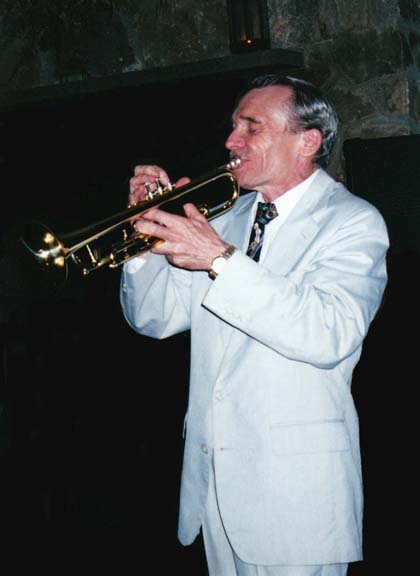
Rocky Rockwell


One of the most popular members of the Lawrence Welk Show is a wonderful trumpet player with an engaging singing style and great flair for comedy. His name is Bland "Rocky" Rockwell. Rocky has always been one of my favorite performers and I have had the pleasure of getting to know him personally. He's as friendly and upbeat as he appears on screen. Now 85 and widowed for 8 years, Rocky lives in Arizona and still performs as a vocalist and valve trombonist.

Despite numerous health problems he remains alert and always full of fun when we talk. Rocky has amazing recall of songs he sang, played, and clowned on during his 11 years on the Welk show.

His story begins in St. Joseph, Missouri where he was born on March 2, 1923. Rocky took to music class as a youngster and showed great ability to sing. When he was told his school band needed trumpet players, he was happy to volunteer. His dad, an electrician, bought Rocky a trumpet at a local pawn shop for $5, a hefty sum in depression days. Rocky was on his way to a career in music. Rocky's dad also introduced him to the many musical broadcasts on his crystal radio set. It was hard for him to tear himself away from the sounds of dance band broadcasts. Following high school and studies at Marysville StateTeachers College ,Rocky began working with territory bands, including a stint with Sonny Dunham. During WW2 Rocky played with the 765th AF Band and saw some time in Europe. While on leave, he married his high school sweetheart, Pauline Wood in 1943.

After the war, it was back to the road with more territory bands. In 1951, Rocky was working in Grand Island, Nebraska on station KMMJ with a polka band. Lawrence Welk happened to be in the area and was looking for a trumpet player. He asked Rocky to audition with the band in St.Joseph! Rocky immediately hopped on a milk train and got back to St. Joe for the date. Lawrence didn't realize that Rocky had all his family and friends in the audience. He got a great reception and was hired by Welk. At the dance Rocky sang Sunny side of the Street which would show Welk his importance as a personality, along with his musicianship. Rocky would be an integral part of the Welk band for the next 11 years.

The band worked their way west to the Aragon ballroom in Santa Monica, and while there started a series of local TV broadcasts that would set the stage for Welk's phenomenal network success. Rocky became a very popular member of the band at the ballroom and TV show with his fine trumpet work, comfortable on dixieland and swing, with a pretty tone, fluid phrasing and easy swing. His vocals, rhythmic and gravelly, recalled other great trumpeter/singers such as the great Louis Armstrong (one of Rocky's favorite musicians), Louis Prima and Scat Davis. Rocky's secret weapon was a great flair for comedy. He shined on the sketches and gags on the show. As he himself said, "You never know what I'll do, when the red light's on." One of Rocky's early signature tunes was I Love Girls. He would repeat it many times over the show's run. He also had a great impish face and crew cut which enhanced his comic style.

On the early shows Rocky showed his versatility doubling on trombone (along with section mates Norm Bailey and Woody Guidry). This experiment wasn't without humor as Rocky had to write out the slide positions on his music. One night at the Hollywood Palladium his slide got away from him and traveled across the dance floor! Thanks to YouTube and PBS Welk reruns we can still enjoy many of Rocky's finest moments.

As a trumpeter Rocky really shone. A 1955 rendition of Randolph St. Strut with the dixieland group shows his fine lead work and a very fleet solo. Larry Hooper also shows what a fine pianist he was with some nice striding. A 1958 big band version of Dipsy Doodle has a marvelous solo by Rocky. Following George Thow (another fine jazzman), he takes a fascinating half-chorus that is Bix-like but with inversions and quick fingerings that are downright boppish! One of my favorite vocal/trumpet routines is on the old favorite I Never Knew I Could Love Anybody. Rock takes a great vocal and a tasty Harmon mute solo. This arrangement was by big band veteran Joe Haymes, who contributed many charts to the early Welk band. On When I Take My Sugar to Tea Rocky goes English gentleman with top hat and ascot and has his trumpet brought out to him on a pillow! Rocky even did an hilarious Elvis impression, finally wrecking his guitar years before the Who. A special moment is on the Christmas show where Rocky played Rudolph for the kids with a cute hand puppet (made by Pauline) fingering the valves. It showed his ease with kids and his own child-like persona.

The man was a superb comic and handled every comedic assignment with the greatest of ease. He also worked well with "Champagne Lady" Alice Lon and bassist Buddy Hayes (another funny guy). One of the best Welk shows was the 1960 big band salute. Rocky had plenty to do with vocal group duties, an Ish Kabbibble imitation, a nice plunger spot on Mood Indigo and a great tribute to Louis on Sunny Side of the Street, capturing Louis' vocal style without being overly hammy as so many Armstrong imitators are. This is one of Rocky's personal favorite spots on the show.

The 1960 Welk band was the largest of his career with strings, five trumpets, four trombones and six saxes. Among the great soloists were George Thow, Warren Luening, Bob Havens, Don Bonnee, Russ Klein, Bill Page and Frank Scott. Also in 1960 Rocky played and sang on Welk's Dixieland album on Dot. Despite a repertoire of children's songs and ditties, the medium size band plays Heinie Beau's great charts with swing and true jazz style much in the way of the Bob Crosby bands.

By 1962 Rocky was ready to leave Welk and try his hand at a solo career. He formed a band that played the Vegas/Tahoe/Reno circuit and played a show that mixed jazz, comedy and standards.
Rocky sometimes opened for Louis Prima and delighted in driving Louis nuts by doing his specialties Oh Marie and Just a Gigolo. For a while former Mouseketeer and Welk Jr. band member Cubby O'Brien was Rocky's drummer. In 1970 Rocky returned to St. Joe to help his dad who was ill. He worked around St. Joe till '83. Then followed cruise work and a move to Sun City, Arizona and a long stay with the house band at the Wigwam resort.

Rocky had two children, a daughter Wynona and son Jeffrey. They both appeared on some of the Welk Christmas shows. Since losing Pauline in 2000, Rocky has worked and recorded with Steve Cooper's fine band from Chicago. He's on three tracks of one of Steve's CDs and does a great version of What a Wonderful World. Rocky can sing pretty tunes with the best of them! Rocky also sings and plays valve trombone with Rte. 66, an Arizona swing band. (He switched to valve trombone after a mouth infection ended his trumpet playing days).

Rocky guest hosted a 2002 Welk PBS show featuring a 1958 broadcast including himself. He made a great host and was full of great stories and anecdotes during the hour. He was also featured on the PBS special Lawrence Welk's TV Treasures. In 2008 Rocky was interviewed by Mary Lou Metzger for a rebroadcast of the 1960 big band show. His humor and reminicing were a highlight of the show.

At 85 and despite various health problems Rocky is still as upbeat and engaging as ever. I always feel so great after talking to him on the phone. He plans on doing some more recording with some of his Arizona friends.

Trumpeter-Vocalist-Comedian and one of the most genuine and talented people to grace a bandstand. That's Rocky. Keep swingin' Rock!

Saturday, August 30, 2008

Bunny Berigan:Trees (12/23/37)


Without a doubt, one of the greatest trumpeters and soloists of the Big Band era was Roland "Bunny" Berigan (1908-42). Bunny's brilliant but short-lived career paralleled that of the legendary Bix Beiderbecke in that alcoholism took him at too early an age. (Bix and Bunny actually worked a few gigs together). Bunny played trumpet with a huge, pure sound, occasionally augmented by growls. He took all kinds of chances on his horn and usually made them. He would go from the lowest points of the horn to the highest in one passage. His lip trills and shakes on high notes were classic trademarks of his style. Bunny idolized Louis (as did Louis, Bunny) and you can hear Louis’ influence, but Bunny also developed a fleet way of running his notes all around the horn without being too busy.

Bunny was born in Fox Lake, Wisconsin and learned violin and trumpet at an early age. He worked with many mid-west bands before making his mark with the Hal Kemp band in 1930. At that time Kemp's band played a mixture of sweet and hot dance music. It didn't take Bunny long to rise to the top of the music world. Besides being a gifted improviser, he could also read and play great lead trumpet. He quickly broke into the studio and record scene of the early 30s. Also he did much free-lancing with top bands such as Fred Rich, The Dorseys, Benny Krueger and Smith Ballew. From 1932-3 he was with Paul Whiteman (another Bix parallel). Following his Whiteman stint, he continued his busy radio and record work.

In 1935 he joined Benny Goodman's new band and helped Benny revolutionize the swing craze. His solos on King Porter Stomp, Sometimes I'm Happy and Blue Skies were important parts of the success of the Goodman band, along with his great lead work. Bunny was so central to the band's success that Goodman put up with his drinking.

Always restless, Bunny left Goodman at the end of 1935 to resume free-lancing. In early 1937 he joined Tommy Dorsey and played a similar role in putting Dorsey's already successful band over in a big way. His solos on Marie and Song of India were two of the greatest improvisations of the era. They became so much a part of the Dorsey book that Tommy had them transcribed for the entire trumpet section. They are still played that way by the current Dorsey band.

With Dorsey's help and backing Bunny started his own band in early 1937. Bunny was not a good businessman or leader, but he could play and always had very musical and swinging bands. He was also a good talent scout. Some of his band graduates included Joe Dixon, Georgie Auld, Ray Coniff, Joe Bushkin, Gus Bivona and Buddy Rich. His recording of I can't get Started became an instant classic and still is. This magnificent series of improvisations and a charming Berigan vocal will always be one of the great solos of the era and has transcended time. There are many wonderful Berigan solos with this band including Prisoner's Song, Jelly Roll Blues, Caravan, Wearin' of the Green and Black Bottom.

One of my personal favorites (and many other musicians) is a magnificent Berigan performance on Trees. This melody was added to the famous Joyce Kilmer poem. On the opening chorus Bunny can be heard playing lead in a cup mute (he still played a lot of lead in his own band). The band is in the key of A for a half chorus. Then it switches to D with the saxes taking over the melody. A sax interlude takes us into Aflat for Bunny's solo. He enters in the low register with that beautiful, fat tone paraphrasing the melody. At one point he hits a low F, not a real trumpet note, but Bunny lips his way down to it. Still paraphrasing the melody, he works his way into the middle register and then a sudden leap into the high register with one of his patented shakes over the band landing on high F. The band picks up the melody and Georgie Auld takes a short tenor spot. The band rides the tune out with Bunny restating the melody over them for the coda. The solo is fairly short, but the passion and daring in Bunny's leaps from low to high register are hallmarks of his exciting and brilliant style. A classic solo!

This Berigan band lasted until late 1939. Bunny was in deep debt and Tommy Dorsey got him out of the hole by offering him a job in his band. For the early part of 1940 Bunny sparked the Dorsey band with great solos and lead work. (Frank Sinatra and Buddy Rich were also in the band). But Bunny's drinking problems finally got the better of him and he left Tommy in August of 1940. After Dorsey he led a small group for a while and did some soundtrack work on the film Syncopation. But Bunny kept trying with various big bands that were usually good musically, but were primarily made up of young musicians. Like Bix the combination of drink and exhaustion finally took him in June of 1942.

Bunny will always be remembered as one of the greatest trumpet soloists of the Swing era. His solos with Goodman, Dorsey and his own bands will be classics forever. His own swing band had its moments and the output of 1937-9 is highly recommended. Trees can be heard on the Classics CD series. Bunny will always be a welcome artist on this post. The ultimate tribute came from Louis Armstrong who never played I Can't get Started out of respect for Bunny. Apparently he did play it once for a special fan and gave it a magnificent reading.

What better tribute to the one and only Bunny Berigan .

Saturday, August 23, 2008

The Three Stooges-Dizzy Doctors (1937)


This short is one of the many classics the team made with Curly during their halcyon years of the mid 30s to early 40s. Dizzy Doctors is a frantic, fast-paced slapstick affair with great gags, fast dialog and more of the familiar Columbia players.

The boys play shiftless husbands who spend the day sleeping while the wives are hard at work. When the wives throw them out of the house to get a job, the boys try selling a new "miracle" product called Brighto. After a series of misadventures, trying to find out what Brighto does, the boys find that it's medicine and head for the nearest hospital to ply their trade.

At the hospital, many tried and true gags are performed (some reminiscent of Men in Black). One patient wants to sleep like Rip Van Winkle, another has dandruff! (Does that warrant a hospital stay?) Needless to say the boys try Brighto on them both! When Moe decides to see the "head" man, it turns out to be our old friend, Vernon Dent (whose car was an earlier victim of Brighto). A wild chase follows thru the hospital, highlighted by more Columbia "chicanery," with stunt doubles and bad voice-overs.

This is part of the charm of the Stooge shorts, picking out the silly studio gaffes. The boys make a hasty exit on a gurney, with a bed sheet as a sail and "sail" home, not without crashing into a taxi cab. The short ends with the Stooges back home in bed, as they began the adventure.

Stooge perennial Bud Jamison also has a small part as a cop who is a victim of "Brighto". Most baby boomers will remember the boys' little chant:Brighto,brighto-makes old bodies new-we'll sell a million bottles-o.Woo woo woo woo woo woo.
Dizzy Doctors is available on Vol.2 of the Sony Stooges collection.

Thursday, August 21, 2008

When it's Sleepy Time Down South-Louis Armstrong


We all know and love Louis Armstrong's theme song, When it's Sleepy time Down South. The composers were two New Orleans friends, Leon and Otis Rene with actor Clarence Muse. Louis first heard the song around 1930 and, as he himself stated, "I carried it in my trunk for a year before recording it." The first recording was in April 1931 followed by a 1932 version that was part of a medley. Between Louis' big band and the All Stars, there must be thousands of live recordings of this wonderful theme that Pops performed at every show. This post will focus on two unique and equally lovely versions.

The November 16, 1941 recording is by Louis' big band and is an instrumental version. The November 28, 1951 version pairs Louis' vocal and trumpet with the talented arranger Gordon Jenkins. Both versions are on the Decca label.

The big band version is quite mellow with Pops stating the melody as only he can. There are no fireworks on this rendition, just Pops playing his beloved theme from the heart. The tempo is very danceable. This must have been a favorite on Pops' dance dates. Saxes play pretty for the release. On the second chorus the band plays a brief riff to bring Louis back for the release. He does some of his patented double-timing, then settles back for some nicely placed high notes as he rides out over the band. This is not the Louis of Swing that Music, but Louis the master melodist. Even though Louis' vocal is missed, he does plenty of singing on his horn.

The Gordon Jenkins version would eventually be part of the Satchmo in Style album. Jenkins had a very distinctive way of writing for strings. He did many ballad sessions for Frank Sinatra. He was also a huge fan of Pops and loved working with him. The string work on this Sleepy Time is gorgeous. The big band version was in the key of Eflat and Louis usually played it in Dflat with the All Stars. The Jenkins arrangement is in C. The different key gives Louis' voice a deeper quality, and his trumpet bridge puts him in the unusual key of E. Despite the strange key, Pops plays a lovely bridge and takes the second eight bars up an octave. His closing vocal lines are very touching as the strings play a cascading figure around his final notes. Pops concludes with an appropriate...Yes, lord!

The 1941 version is on the Classics Cd series and Satchmo in Style is on a Verve CD (with extra material).

Until our next Louis post--

Good evening everybody!

Thursday, August 14, 2008

Johnnie "Scat" Davis: Hooray for Scat


One of the most intriguing personalities of the Dance Band era was trumpeter-vocalist-bandleader-actor Johnnie "Scat" Davis. Perhaps this diversity in his career was the reason for his musicianship being forgotten over the years.

Johnnie was born in Brazil, Indiana on May 11, 1910. His father and grandfather were concert musicians and he had some musical brothers. (Trumpeter Art Davis worked in Johnnie's big band in the 40s.) Johnny became proficient on trumpet by his teens and worked with local stage and dance bands. At one show Johnnie sang a vocal and was complimented by an old minstrel man, Lassus White. He referred to Johnnie's singing as "scat," but he meant ad-libbing as opposed to Louis Armstrong's horn-like scatting. However, the nickname stuck.

Johnnie's early professional years were spent hopping around the country with territory bands such as Jimmy Joy and Smith Ballew. As early as 1930 he recorded with his own band for Broadway but these sides are extremely rare. While with Ballew in New York City in 1931, he recorded a vocal on Sugar (not the standard) for the Crown label. He also recorded four sides for Victor in 1932 with a trio. They were rejected.

By mid-1931 Johnnie was working frequently with Red Nichols at the Park Central and recorded some Brunswick sides with him. Most of the Nichols sides feature Johnnie on vocals (sounding quite like the popular studio singer Dick Robertson). He also gets in a fine plunger solo on Nichol's record of Get Cannibal. Johnnie also worked for Will Osbourne for a time and "fronted" the Casa Loma Orchestra for a short time before Glen Gray became leader.

Late in 1931 Johnnie joined the popular Fred Waring Band. Waring, like Paul Whiteman, featured a large troupe of musicians and singers. Johnnie did some novelty vocals with the band and took most of the jazz trumpet spots. Two good examples from this period are How'm I Doin’ and I Heard with Davis on vocals and trumpet. In October 1934 and September 1935 Johnnie made 12 sides for the Decca label.

This was a studio band and featured many New York City studio pros such as Bunny Berrigan, Mannie Klein, Floyd O'Brien, Frank Froeba, Artie Shaw and Lennie Johnson (guitar). Johnnie sings and plays trumpet on all the sides, mostly pop tunes of the day. Highlights include College Rhythm with a fine vocal and trumpet coda combining Louis and Red Nichols. Congratulate Me has fine plunger work and nice guitar from Johnson (very Dick McDonough-like). Take a Number from One to Ten has great O'Brien trombone and a swingin vocal by "Scat." Loafin' Time is a pleasant tune in the style of Lazy Bones. I Feel a Song Comin' On has Johnnie in great vocal form. These sides deserve to be heard. Besides Johnnie's fine work, they are an excellent example of pre-swing era dance music.

Johnnie continued with Waring through the 30s, occasionally taking sabbaticals to front his own groups. He also had a brief run at the Hickory House with Frank Trumbauer in the early part of 1937. (I believe some of the airchecks have come out on a Trumbauer CD.)

A word or two on Johnnie's trumpet and vocal style. His later success as an actor and novelty singer obscured the fact that he played fine trumpet. The influence of Louis Armstrong is obvious (not unusual), but there is also a brisk staccato-like attack reminicent of his former boss, Red Nichols. Johnny liked to use the cup and harmon mutes to get a "buzzy" sound to his horn. He also played with quite a bit of power and had no trouble getting into the upper register of the horn (again a la Louis). On vocals he had a flexible tenor voice, sometimes with a bite or rasp, but also pleasant on ballads. Fellow horn men Louis Prima and Tony Pastor had similar approaches to "Scat." Johnny continued as a popular member of Waring's troupe thru the 30s.

In 1937 the Waring band appeared in a Warner Bros. musical called Varsity Show. This was a typical campus musical. Johnnie sang a few tunes in the picture and registered well as a comedic character actor. Warners' liked what they saw and retained Johnnie's services for a series of musicals and comedies.He had a plum supporting role in the football comedy Over the Goal(1937) also starring William "Paul Drake" Hopper, June Travis and Eddie "Rochester" Anderson.Johnnie stood out as freshman water boy Tiny Waldron and sang a bit of Rollin' Off a Log and a cute novelty called Scattin' with Mr. Bear which featured some hot horn work. He even did a vocal and trumpet bit in a Vitaphone cartoon, Katnip Kollege (1938.)Johnnie's cat character reprised Rollin' Off a Log (sung to mabel Todd's "Kitty") and part of his cornet solo from Mr. Bear was edited in. But the picture that really put Johnnie over was Hollywood Hotel (1937.)

The film starred Dick Powell, The Lane Sisters (Waring alumni), Frances Langford and Benny Goodman's band. At the beginning of the film Johnnie, Frances, Benny and the band see Dick off at the airport and perform Hooray for Hollywood (Richard Whiting-Johnny Mercer.) This version with "Scat" featured on some lively vocalizing has become a classic and became "Scat's" theme with his own groups. In the movie Johnnie is supposed to be a member of the Goodman band, but he just lip-synched his part with the trumpet section. (With all due respect to Johnnie Benny had Harry James, Ziggy Elman and Chris Griffin!) To this day when TV shows do a Hollywood-theme they usually trot out this version with Johnnie scatting away.

Another good showcase for Johnnie was Garden of the Moon (1938.) John Payne played the leader of a swing band (actually Joe Venuti's band) and "Scat" was a featured musician and John's sidekick in the film. Also featured were Pat O'Brien, Margaret Lindsey and Jerry Colonna as a trombonist in the band. (Jerry was a fine player before concentrating on comedy.) Between "Scat," Joe and Jerry there are many funny vocals and instrumental bits. Johnnie gets in some good trumpet licks and is featured on Girl Friend of the Whirling Dervish and Lady on the Two Cent Stamp.

Johnnie made a total of ten films for Warners'. The 1938 film Mr. Chump gave Johnnie the starring role supported by Penny Singleton and Lola Lane. He played a trumpeter with a get-rich scheme. Johnnie got to play and sing several numbers. The big number was As Long As You Live (also recorded by Tommy Dorsey's Clambake 7)performed in a dance hall scene. Scat also does some nice blowing on Bob White and Listen to the Mocking Bird and accompanies Penny's vocal on It's Against the Law in Arkansas. Although a minor B picture, Johnnie's vocals,trumpet and comic abilities are well showcased. (The film was recently shown on Turner Classic Movies).

After 1939 Warners' cut down on their musicals and let Johnnie go. His movies had made him a recognizable figure so he put together a swing band and started touring. The Johnnie "Scat" Davis band had a very successful start at the Blackhawk in Chicago.

A 1939 promo in Down Beat shows him with vocalist Gloria Van. Much of his activity during these years is obscured. As Johnnie himself said, he had become popular in the movies so the band did a lot of theatre dates. Johnnie led some good bands during the swing era and sidemen included Conrad Gozzo, Kenny Trimble, Buddy deFranco, Dodo Marmarosa and Mel Grant. The band made a few movie shorts and four sides for the Hit label in 1942. Hip Hip Hooray is the only side that features Johnnie's horn and voice. The other sides are routine pop arrangements. (Johnnie has a brief solo on At Last.)

In 1943 Johnnie and the band made a low budget film for Monogram called Sarong Girl. (The band onscreen is fairly small.) Burlesque star Ann Corio had the title role and Johnnie once again excelled as a comic sidekick-musician. He gets a great feature on Darling Nellie Gray. His trumpet work is very Louis-ish including a cadenza right out of Pops. In 1944 Johnnie made his last films, You Can't Ration Love and Knickerbocker Holiday, a campus musical and film version of the play with Johnnie in a supporting role.

Johnnie continued leading his big band into the late 40s. A 1946 transcription finds Johnnie in good form on Buzz me, Honeydripper and Hey, Baba Rebop. He also contributes a mellow vocal on Hoagy Carmichael's lovely Memphis in June. The band sounds full of fun and really jumps. It has a lot of the feel of Louis Prima's big bands of the time.

Around 1948 Johnnie scaled down to a small group called the Scat-tet. A 1948 transcription finds the band playing 'Swonderful, Mean to Me and I Can't Give You Anything but Love. Johnnie's trumpet work on these is especially good and on Mean to Me he hits some Louis-ish high notes. There is a fine tenor sax and vibes player in this band. Bassist Jack Wyatt, later with Jim Cullum, was a member of this band. Johnnie did some recording for the Universal label of Chicago in 1948. I believe the tunes in the transcription come from these sessions. He made a swinging re-make of Hooray for Hollywood at these sessions.

In the early 50s, Johnnie popped up on his own TV show out of Detroit, Coffee and Cakes. I'm sure this was done live and we don't have any tapes of the show available. He also did at least one side for Dizzy Gillespie's short-lived DeeGee label.One of the tunes was Gambler's Blues by Phil Baxter, an old colleague of Johnnie's. Johnnie's activities in the 50s are hard to trace. I know he started doing regular small band dates in Vegas, probably by the early 60s.

In 1959 a King LP was issued by Johnnie called Here's Lookin' Atcha. These sides probably come from the Universal sessions. The album is a real mixed bag, part dixieland, part swing, part R&B. It even has some organ on some sides, a nice touch. Johnnie's horn is featured very nicely on most selections. (The album is instrumental.) His Body and Soul is inspired with great phrasing and a take off on Bunny's Can't Get Started ending. After You've Gone and Baby,Won't You Please Come Home also feature nice horn work, although he's straining a bit on the high ones on Baby. The dixie tunes Muskrat, That's a Plenty and Tin Roof feature Johnnie on solid lead and some of that stacatto attack. St. James Infirmary has a nice solo by John and a vamp similar to Red Nichol's Wail of the Winds.

Despite the odd mixture of tunes, the album shows Johnnie's abilities as a jazzman and leader. The dixie tunes have a unique front line of trumpet, clarinet and baritone sax. This album is well worth seeking out on Ebay or in second hand shops. In the 60's Johnnie settled in Arlington,Texas with his wife Martha and daughters, Nancy and Judy. He played local dates and took bands to Vegas, Reno and Tahoe for regular appearances. For a good example of his Vegas band, go to John Gates.com. John played drums for "Scat" in the mid 60's and has a nice audio clip of one of "Scat's" shows. John was playing mostly bass trumpet. He was having some chop trouble, but he sounds good on Basin St. and So Long Dearie. His singing is delightful and he is a fine emcee.

I had a chance to talk to the late Jack Wyatt, who did some of Johnnie's Texas gigs. He said that "Scat" was a great entertainer and great guy to work for.

Through a fellow collector I was able to get a copy of a radio show John did in the late 70's in Arlington,Texas. The show was hosted by Jim Lowe. He and a fellow collector chat with Johnnie who talks about his years in the business and reacts to some of his recordings. "Scat" comes across as a nice, good-humored guy who knows his place in music history, but doesn't come off as an egotist. In 1981 Johnnie was one of the bands that played for President Reagan's Inaugural Ball. He and Ron were colleagues at Warner Bros. and had kept in touch over the years. Johnnie continued to work around Texas until his death from a heart attack on November 25, 1983. He was booked to play New Year's Eve at Dallas' Fairmont Hotel.

Though not a major player on the jazz/swing roster, Johnnie brought lots of fun and good jazz to his audiences for many years.

Hooray for you, Scat.

Addendum- Recently we acquired a curio- an LP of vocalist Patti James backed by the Johnnie "Scat" Davis Orch. The album appears to be a souveneir of an engagement Miss James played in Dallas with Scat's band. The promo picture of Scat on the cover suggests the period of mid to late 60s. The 12 piece band is a good one, it sounds like an augmented version of Scat's Vegas band.
Miss James is a talented entertainer and from her photo, a good looker. There isn't much here for fans of Scat ( he is obviously leading the band-no trumpet work), until the last cut, a swinging duet of Ol' Man River with Patti and Scat. Apparently, they had been doing this number during the run of the show. Scat is in good form, his elastic voice jumping all around and throwing in some nice scat passages. This album is for Scat completists only, however it shows him to still be a fine entertainer and front man.

Tuesday, August 12, 2008

Schilling and Lane:Forgotten Comedy Heroes


The success of the Three Stooges at Columbia prompted the studio to try out other teams from their roster trying to capture the magic of the Stooges. The best of these concocted teams was that of Gus Schilling and Richard Lane. Both actors were old comedy pros with lots of experience in show biz. Gus Schilling (1908-57) was born in New York City, had been a stage and burlesque performer and had many years of movie character parts before teaming with Lane. Richard Lane (1899-1982) was born in Wisconsin. He worked from circuses to vaudeville and finally to films. He was a versatile character actor and fans of Columbia's Boston Blackie series will remember him as Inspector Farraday.

Many of the manufactured teams were talented, but had no chemistry. Gus and Dick were a perfect team. Schiling, the jittery, rubber-faced fall guy and Lane, the fast-talking Bud Abbott prototype. Both comics were very adept at the Columbia slapstick style and benefitted from that great stock cast and crew of writer/directors. Although many of their films were remakes of Stooge and other Columbia comedies, the boys managed to breathe new energy into these "old favorites."

The first short in the series was High Blood Pressure (1945). This is a top-notch entry with Dick posing as a doctor to avoid a speeding ticket. He has to "bluff" his way thru an operation on Gus. At the hospital many tried and true gags are revived, but S&L put their own manic spin on things.

Their best short is Two Nuts in a Rut (1948). Dick plays an overworked movie director with Gus as his goofy assistant. When Dick heads to Palm Springs for a needed rest, the boys get involved in a typical Columbia domestic triangle comedy. The lovely, all-purpose Columbia leading lady, Christine McIntyre, is the wife of a wrestler (Dick Wessell). Of course Dick's wife thinks he's got something going on. Claire Carleton, a cute blonde and talented comedienne, is a hoot as a would-be actress after a job from Lane. The wonderful Emil Sitka (a Columbia stalwart) has a funny cameo as a screwy chiropodist. Schilling and Lane's fast dialog and easy rapport with slapstick make this one of the better Columbia comedies.

A real curio in the series is Pardon my Terror (1946). Originally planned as a 3 Stooges short it was reworked for S&L when Curly Howard suffered a stroke. Gus and Dick play hapless detectives hired by a beautiful damsel-in-distress (our girl Christine) to find her missing uncle (Vernon Dent). The boys arrive at the family estate and go thru their paces as a gang of crooks (Kenneth McDonald, Lynne Lyons and Dick Wessell) try to eliminate them.The usual scare gags abound, but S&L do a great job with the Stooge material. (The short was remade by the Stooges in 1949 as Who Done It? with Shemp).

Stooge fans will also enjoy Training for Trouble (1947). This is a scene-by-scene remake of a Stooge classic A Pain in the Pullman (1936). Gus and Dick play the hammy vaudevillians who along with their pet monkey, reign havoc on a train carrying the show's cast. Sid Fields of Abbott and Costello fame plays the foil, Paul Paine. The Columbia veteran, Monte Collins, is the harried company manager, Johnson! (Remember Bud Jamison in the original?) The boys do a great job with the familiar material and Columbia even uses the closing gag from the original film. (Paine is added to match up with the Stooges). Columbia always saved every bit of film.

The series ended in 1950. Gus wound up in an Andy Clyde comedy in 1953, but died four years later of a heart attack. Dick had a long career in California TV including longtime announcing duties at roller derbies and wrestling matches. Both men will be remembered as talented, hard working comics in a great if not original series at the Columbia fun factory.

My VHS copies of the films were obtained from private collections. Hopefully with the advent of DVD, someone will take an interest in the series and issue some of the best shorts.

Till our next comedy post...keep laughing.

Saturday, August 9, 2008

The Bix Beiderbecke Legend


The creative and innovative music of Bix Beiderbecke will always be a feature of this blog. I thought it would be appropriate to start with an overview of Bix's wonderful music and tragic life. As a young trumpet student getting into jazz, I was intrigued by an RCA album called The Bix Beiderbecke Legend.

I had heard of Bix, but I sensed there was something special about the cartoon of the dapper young man in tuxedo holding a cornet on the album cover. There was something special. The sound of Bix's horn was different from that of Louis Armstrong, who I had just discovered. But it was a nice kind of different. Thus began my life-long love affair and fascination with Bix's music.

We won't dwell on the biographical facts. They are well-covered in Richard Sudhalter and Philip Evans' definitive book, Bix:Man and Legend (Arlington House 1974). Leon Bix Beiderbecke (Bix is a family nickname for Bismark) was born on March 10, 1903 in Davenport, Iowa. He grew up in a comfortable middle class family of German stock who were local coal merchants. He gravitated to music early, first on piano, then on cornet. When his older brother returned from WWI with some phonograph records of The Original Dixieland Jazz Band, Bix was hooked on jazz and his lot in life was set. Bix was soon sitting in and playing with local bands. He also heard the young Louis Armstrong playing on a riverboat in Davenport with the Fate Marable Band.

When his parents enrolled him at Lake Forest Academy in Illinois, looking for structure and discipline for their son, little did they know that they were sending Bix to finishing school in jazz, courtesy of nearby Chicago. Bix's nightly trips to Chicago introduced him to the likes of King Oliver, Louis Armstrong and the New Orleans Rhythm Kings. His days at Lake Forest would soon be over and he would become a professional musician against his parent's wishes.

By 1923 Bix had landed with a promising mid-west band called the Wolverine Orchestra where he made his first recordings and made his mark on the jazz world. One of the band's biggest fans was a young law student-pianist/composer named Hoagy Carmichael. He and Bix would become fast friends. The style of Bix's horn that attracted Hoagy, Louis, Paul Whiteman, Red Nichols, Bing Crosby and countless other musicians was a clear, bell-like tone. His ideas were melodic. He could play hot, but there was always a sense of form and grace to his phrasing. Bix opened up the doors to "pretty" players such as Bobby Hackett and Chet Baker along with numerous players and singers. One of Hoagy's earliest compositions was a piece called Riverboat Shuffle, written for Bix and The Wolverines.

Many critics and fans have noticed the Bix-like lines in the verse and chorus of his all-time classic Stardust, written in 1927 at the height of Bix's powers.

In quick succession Bix went from The Wolverines to Jean Goldkette and Frank Trumbauer and finally Paul Whiteman. (The King of Entertainment, not Jazz, that was Louis' title.) Among Whiteman's roster were the Dorsey Bros, Bing, Joe Venuti, Eddie Lang, Henry Busse, Bill Rank, Chester Hazlett and great arrangers such as Bill Challis, Lenny Hayton and Ferde Grofe.

In Trumbauer Bix found a colleague and mentor. He encouraged Bix and helped him with his reading. One of the many "legends" was that Bix couldn't read music and had a wild west magazine on his music stand. He was a slow, but adequate reader. Bix also began his fascination with classical music, especially the works of Ravel, Debussy and an obscure American composer, Eastwood Lane. These elements would crop up in his horn work, but moreso in his piano playing and compositions.

With Trumbauer and his own "gang", Bix made some of the greatest jazz sides of all time including Singin' the Blues, I'm Comin' Virginia, Jazz me Blues, Royal Garden Blues and his fascinating, impressionistic piano solo and composition, In a Mist. In the orchestral settings of Goldkette and Whiteman his contributions ranged from decorative 4 and 8 bar passages to the monumental. He could take over the entire 32-piece Whiteman orchestra and make it swing on From Monday On or Lonely Melody.

Sad to say, at the tender age of 25 in 1928, Bix's best days would soon be behind him. Since his early playing days, Bix had been fighting a losing battle with alcohol. Some of this might have stemmed from the lack of acceptance by his parents. Even though Bix was working with the top orchestra in the land and making $200 a week in 1927, his parents couldn't accept his occupation.

By December 1928 Bix was in and out of the Whiteman band, trying rest and rehab to battle his demons. When Bix returned to Whiteman in early'29, Paul retained Andy Secrest, Bix's sound-alike replacement as insurance. Finally in September 1929 Bix broke down at a Whiteman record session. He returned home to Davenport for more rest and a planned return to Whiteman who kept him on salary. That return never came.

The last two years of his life were spent in New York playing casual dates, radio, some recording and a lot of work on his compositions. Bill Challis helped put his three remaining compositions on paper. (Bix never got to record them, but many pianists and bands did).

The end came on August 6, 1931 when Bix's frail alcohol-ridden body gave out. The cause of death was pneumonia. The years of alcohol and bad habits had caught up with him at 28 years of age.

Fortunately, we have many great Bix moments on record. Even 80 plus years later, his improvisations still sound fresh and creative. They always will.

I'd like to mention two excellent films on Bix. Bix-ain't none of them play like him yet by Bridgette Berman (1981 Playboy Video) is a fascinating documentary with many interviews of colleagues and bandmates. The second is Bix:Interpretation of a Legend (1990 Rhapsody Films, Italy) starring musician/ writer/actor Bryant Weeks as Bix. Some of the chronology is disjointed, but this is a very sincere portrayal of Bix's life with great period music by Bob Wilber and great cornet solos by Tom Pletcher.

Till next time. BIX LIVES!